Advertisements
Advertisements
प्रश्न
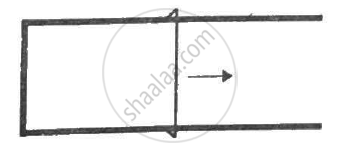
Figure shows a metallic wire of resistance 0.20 Ω sliding on a horizontal, U-shaped metallic rail. The separation between the parallel arms is 20 cm. An electric current of 2.0 µA passes through the wire when it is slid at a rate of 20 cm s−1. If the horizontal component of the earth's magnetic field is 3.0 × 10⁻⁵ T, calculate the dip at the place.
Advertisements
उत्तर
Given:-
Separation between the parallel arms, l = 20 cm = 20 × 10−2 m
Velocity of the sliding wire, v = 20 cm/s = 20 × 10−2 m/s
Horizontal component of the earth's magnetic field, BH = 3 × 10⁻⁵ T
Current through the wire, i = 2 µA = 2 × 10⁻⁶ A
Resistance of the wire, R = 0.2 Ω
Let the vertical component of the earth's magnetic field be Bv and the angle of the dip be δ.
Now,
\[i = \frac{B_v lv}{R}\]
\[\Rightarrow B_v = \frac{iR}{lv}\]
`=(2xx10^-5xx2xx10^-1)/(20xx10^-2xx20xx10^-2)=(2xx2xx10^-7)/(2xx2xx10^-2)`
\[= 1 \times {10}^{- 5} T\]
We know,
\[\tan\delta = \frac{B_v}{B_H} = \frac{1 \times {10}^{- 5}}{3 \times {10}^{- 5}} = \frac{1}{3}\]
\[ \Rightarrow \delta = \tan^{- 1} \left( \frac{1}{3} \right)\]
APPEARS IN
संबंधित प्रश्न
Using the concept of force between two infinitely long parallel current carrying conductors, define one ampere of current.
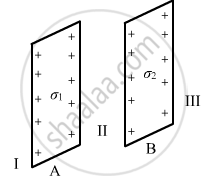
Two infinitely large plane thin parallel sheets having surface charge densities σ1 and σ2 (σ1 > σ2) are shown in the figure. Write the magnitudes and directions of the net fields in the regions marked II and III.
An electron beam projected along the positive x-axis deflects along the positive y-axis. If this deflection is caused by a magnetic field, what is the direction of the field? Can we conclude that the field is parallel to the z-axis?
Two parallel, long wires carry currents i1 and i2 with i1 > i2. When the currents are in the same direction, the magnetic field at a point midway between the wires is 10 µT. If the direction of i2 is reversed, the field becomes 30 µT. The ratio i1/i2 is
A copper wire of diameter 1.6 mm carries a current of 20 A. Find the maximum magnitude of the magnetic field `vecB` due to this current.
A hypothetical magnetic field existing in a region is given by `vecB = B_0 vece` where `vece`_r denotes the unit vector along the radial direction. A circular loop of radius a, carrying a current i, is placed with its plane parallel to the x−y plane and the centre at (0, 0, d). Find the magnitude of the magnetic force acting on the loop.
The magnetic field existing in a region is given by `vecB = B_0(1 + x/1)veck` . A square loop of edge l and carrying a current i, is placed with its edges parallel to the x−y axes. Find the magnitude of the net magnetic force experienced by the loop.
A rectangular coil of 100 turns has length 5 cm and width 4 cm. It is placed with its plane parallel to a uniform magnetic field and a current of 2 A is sent through the coil. Find the magnitude of the magnetic field B if the torque acting on the coil is 0.2 N m−1
Two parallel wires carry equal currents of 10 A along the same direction and are separated by a distance of 2.0 cm. Find the magnetic field at a point which is 2.0 cm away from each of these wires.
Two long, straight wires, each carrying a current of 5 A, are placed along the x- and y-axis respectively. The currents point along the positive directions of the axes. Find the magnetic fields at the points (a) (1 m, 1 m), (b) (−1 m, 1 m), (c) (−1 m, −1 m) and (d) (1 m, −1 m).
Two parallel wires separated by a distance of 10 cm carry currents of 10 A and 40 A along the same direction. Where should a third current by placed so that it experiences no magnetic force?
Two long parallel wires kept 2 m apart carry 3A current each, in the same direction. The force per unit length on one wire due to the other is ______.
The figure below are two long, parallel wires carrying current in the same direction such that I1 < I2.

- In which direction will wire I1 move?
- If the direction of the current I2 is reversed, in which direction will the wire I1 move now?
When two long, straight, current-carrying conductors are placed parallel to each other and the currents flow in the same direction, the conductors:
By symmetry, the magnetic field of conductor b exerts a force on conductor a. The relationship between the two forces Fba and Fab is:
The SI unit of the permeability of free space (μ₀) is:
If the current Ia in conductor a is doubled while Ib and the distance d remain unchanged, the force per unit length F/L between the conductors:
A wire carrying a current of 1 A flows East → West in a region where the horizontal component of Earth's magnetic field is B = 3.0 × 10⁻⁵ T directed South → North. The force per unit length on the wire is:
