Advertisements
Advertisements
प्रश्न
Two long parallel wires kept 2 m apart carry 3A current each, in the same direction. The force per unit length on one wire due to the other is ______.
विकल्प
4.5 × 10⁻⁵ Nm-1, attractive
4.5 × 10⁻⁷ N/m, repulsive
9 × 10⁻⁷ N/m, attractive
9 × 10⁻⁵ N/m, attractive
Advertisements
उत्तर
Two long parallel wires kept 2 m apart carry 3A current each, in the same direction. The force per unit length on one wire due to the other is 9 × 10⁻⁷ N/m, attractive.
Explanation:
Given I1 = I2 = 3 A, d = 2 m, the current is flowing in the same direction,
Now, `F/l = (mu_0I_1I_2)/(2pid)`
= `(4pi xx 10^-7 xx 3 xx 3)/(2pi xx 2)`
= 9 × 10⁻⁷ N/m
`F/l = 9 xx 10^-7` N/m
संबंधित प्रश्न
An electron beam projected along the positive x-axis deflects along the positive y-axis. If this deflection is caused by a magnetic field, what is the direction of the field? Can we conclude that the field is parallel to the z-axis?
A long, straight wire of radius R carries a current distributed uniformly over its cross section. T he magnitude of the magnetic field is
(a) maximum at the axis of the wire
(b) minimum at the axis of the wire
(c) maximum at the surface of the wire
(d) minimum at the surface of the wire.
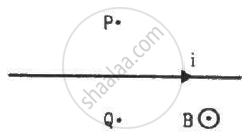
A long, straight wire carrying a current of 1.0 A is placed horizontally in a uniform magnetic field B = 1.0 × 10⁻⁵ T pointing vertically upward figure. Find the magnitude of the resultant magnetic field at the points P and Q, both situated at a distance of 2.0 cm from the wire in the same horizontal plane.
The magnetic field existing in a region is given by `vecB = B_0(1 + x/1)veck` . A square loop of edge l and carrying a current i, is placed with its edges parallel to the x−y axes. Find the magnitude of the net magnetic force experienced by the loop.
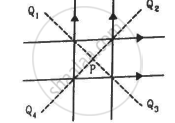
Four long, straight wires, each carrying a current of 5.0 A, are placed in a plane as shown in figure. The points of intersection form a square of side 5.0 cm.
(a) Find the magnetic field at the centre P of the square.
(b) Q1, Q2, Q3, and Q4, are points situated on the diagonals of the square and at a distance from P that is equal to the diagonal of the square. Find the magnetic fields at these points.
A straight, how wire carries a current of 20 A. Another wire carrying equal current is placed parallel to it. If the force acting on a length of 10 cm of the second wire is 2.0 × 10⁻⁵ N, what is the separation between them?
If a current I is flowing in a straight wire parallel to x-axis and magnetic field is there in the y-axis then, ______.
Beams of electrons and protons move parallel to each other in the same direction. They ______.
