Advertisements
Advertisements
प्रश्न
Answer the following question.
Two infinitely long straight wire A1 and A2 carrying currents I and 2I flowing in the same direction are kept' distance apart. Where should a third straight wire A3 carrying current 1.5 I be placed between A1 and A2 so that it experiences no net force due to A1 and A2? Does the net force acting on A3 depend on the current flowing through it?
Advertisements
उत्तर
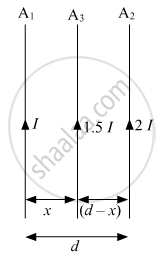
The force per unit length between two infinitely long, parallel current-carrying wires is given by:
`F = μ_0/(2pi) (I_1I_2)/d`
where:
- I1 and I2 are the currents in the wires,
- d is the separation between them,
- μ0 is the permeability of free space.
Assigning Given Values
- A1 carries current I.
- A2 carries current 2I.
- The distance between A1 and A2 is d.
- A3 carries current 1.5I and is to be placed somewhere between A1 and A2.
For A3 to experience zero net force, the magnitudes of these forces must be equal:
F1 = F2
`μ_0/(2pi) (Ixx1.5I)/x = μ_0/(2pi) (2Ixx1.5I)/((d-x)`
`(1.5I^2)/x = (3I^2)/(d-x)`
`1/x = 2/(d-x)`
d − x = 2x
d = 3x
`x = d/3`
APPEARS IN
संबंधित प्रश्न
Two parallel, long wires carry currents i1 and i2 with i1 > i2. When the currents are in the same direction, the magnetic field at a point midway between the wires is 10 µT. If the direction of i2 is reversed, the field becomes 30 µT. The ratio i1/i2 is
A long, straight wire carries a current along the z-axis, One can find two points in the x−y plane such that
(a) the magnetic fields are equal
(b) the directions of the magnetic fields are the same
(c) the magnitudes of the magnetic fields are equal
(d) the field at one point is opposite to that at the other point.
Two long, straight wires, each carrying a current of 5 A, are placed along the x- and y-axis respectively. The currents point along the positive directions of the axes. Find the magnetic fields at the points (a) (1 m, 1 m), (b) (−1 m, 1 m), (c) (−1 m, −1 m) and (d) (1 m, −1 m).
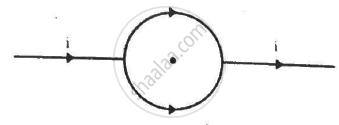
A conducting circular loop of radius a is connected to two long, straight wires. The straight wires carry a current i as shown in figure. Find the magnetic field B at the centre of the loop.
According to Ampere's circuital law, ______.
Do magnetic forces obey Newton’s third law. Verify for two current elements dl1 = dlî located at the origin and dl2 = dlĵ located at (0, R, 0). Both carry current I.
Five long wires A, B, C, D and E, each carrying current I are arranged to form edges of a pentagonal prism as shown in figure. Each carries current out of the plane of paper.

- What will be magnetic induction at a point on the axis O? AxisE is at a distance R from each wire.
- What will be the field if current in one of the wires (say A) is switched off?
- What if current in one of the wire (say) A is reversed?
Beams of electrons and protons move parallel to each other in the same direction. They ______.
Two long, straight, parallel conductors carry currents flowing in opposite directions (antiparallel currents). The magnetic force between them is:
The force per unit length between two long parallel current-carrying conductors carrying currents I₁ and I₂, separated by a perpendicular distance d, is given by:
