Advertisements
Advertisements
प्रश्न
A long, straight wire carries a current i. Let B1 be the magnetic field at a point P at a distance d from the wire. Consider a section of length l of this wire such that the point P lies on a perpendicular bisector of the section B2 be the magnetic field at this point due to this second only. Find the value of d/l so that B2 differs from B1 by 1%.
Advertisements
उत्तर
Given:
Magnitude of current = i
Separation of the point from the wire = d

Thus, the magnetic field due to current in the long wire is given by
\[B_1 = \frac{\mu_0 i}{2\pi d}\]
Also, the magnetic field due to a section of length l on a perpendicular bisector is given by
\[\Rightarrow \frac{\mu_0 i l}{4\pi d}\frac{2}{d\sqrt{\frac{l^2}{d^2} + 4}}\]
\[\text{ Neglecting } \frac{l^2}{d^2} \left( \text{ very small } \right), \text{ we get } \]
\[ B_2 = \frac{\mu_0 i l}{4\pi d^2} \times \frac{2}{\sqrt{2}}\]
\[ = \frac{\sqrt{2} \mu_0 i l}{4\pi d^2}\]
Now,
B1 > B2
According to the question,
\[\frac{B_1 - B_2}{B_1} = \frac{1}{100}\]
\[ \Rightarrow B_2 = 0 . 99 B_1 \]
\[ \Rightarrow \frac{\sqrt{2} \mu_0 il}{4\pi d^2} = 0 . 99 \times \frac{\mu_0 i}{2\pi d}\]
\[ \Rightarrow \frac{d}{l}=\frac{1 . 414}{1 . 98}=0.71\]
APPEARS IN
संबंधित प्रश्न
What is the magnitude of magnetic force per unit length on a wire carrying a current of 8 A and making an angle of 30° with the direction of a uniform magnetic field of 0.15 T?
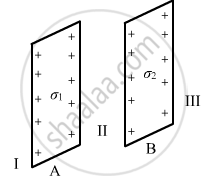
Two infinitely large plane thin parallel sheets having surface charge densities σ1 and σ2 (σ1 > σ2) are shown in the figure. Write the magnitudes and directions of the net fields in the regions marked II and III.
An electron is moving along the positive x-axis. You want to apply a magnetic field for a short time so that the electron may reverse its direction and move parallel to the negative x-axis. This can be done by applying the magnetic field along
(a) y-axis
(b) z-axis
(c) y-axis only
(d) z-axis only
Two parallel, long wires carry currents i1 and i2 with i1 > i2. When the currents are in the same direction, the magnetic field at a point midway between the wires is 10 µT. If the direction of i2 is reversed, the field becomes 30 µT. The ratio i1/i2 is
A long, straight wire carries a current along the z-axis, One can find two points in the x−y plane such that
(a) the magnetic fields are equal
(b) the directions of the magnetic fields are the same
(c) the magnitudes of the magnetic fields are equal
(d) the field at one point is opposite to that at the other point.
A transmission wire carries a current of 100 A. What would be the magnetic field B at a point on the road if the wire is 8 m above the road?
A long, straight wire of radius r carries a current i and is placed horizontally in a uniform magnetic field B pointing vertically upward. The current is uniformly distributed over its cross section. (a) At what points will the resultant magnetic field have maximum magnitude? What will be the maximum magnitude? (b) What will be the minimum magnitude of the resultant magnetic field?
A hypothetical magnetic field existing in a region is given by `vecB = B_0 vece` where `vece`_r denotes the unit vector along the radial direction. A circular loop of radius a, carrying a current i, is placed with its plane parallel to the x−y plane and the centre at (0, 0, d). Find the magnitude of the magnetic force acting on the loop.
Three coplanar parallel wires, each carrying a current of 10 A along the same direction, are placed with a separation 5.0 cm between the consecutive ones. Find the magnitude of the magnetic force per unit length acting on the wires.
Two parallel wires separated by a distance of 10 cm carry currents of 10 A and 40 A along the same direction. Where should a third current by placed so that it experiences no magnetic force?
Define Ampere in terms of force between two current carrying conductors.
If a current I is flowing in a straight wire parallel to x-axis and magnetic field is there in the y-axis then, ______.
A milli voltmeter of 25 milli volt range is to be converted into an ammeter of 25 ampere range. The value (in ohm) of necessary shunt will be ______.
The nature of parallel and anti-parallel currents are ______.
Do magnetic forces obey Newton’s third law. Verify for two current elements dl1 = dlî located at the origin and dl2 = dlĵ located at (0, R, 0). Both carry current I.
Two long straight parallel conductors carrying currents I1 and I2 are separated by a distance d. If the currents are flowing in the same direction, show how the magnetic field produced by one exerts an attractive force on the other. Obtain the expression for this force and hence define 1 ampere.
Two long parallel wires kept 2 m apart carry 3A current each, in the same direction. The force per unit length on one wire due to the other is ______.
