Advertisements
Advertisements
प्रश्न
A long, straight wire of radius r carries a current i and is placed horizontally in a uniform magnetic field B pointing vertically upward. The current is uniformly distributed over its cross section. (a) At what points will the resultant magnetic field have maximum magnitude? What will be the maximum magnitude? (b) What will be the minimum magnitude of the resultant magnetic field?
Advertisements
उत्तर
(a) As the wire in question is carrying current, so it will also generate a magnetic field around it. And for a long straight wire it will be maximum at the mid-point called P.
Now,
Magnetic field generated by the current carrying wire \[= \frac{\mu_o i}{2\pi r}\]
Net magnetic field = \[B + \frac{\mu_0 i}{2\pi r}\]
(b) Magnetic field B = 0
when \[r < \frac{\mu_0 i}{2\pi B}\]
Clearly,
B = 0
when
\[r = \frac{\mu_0 i}{2\pi B}\]
But when \[r > \frac{\mu_0 i}{2\pi B}\]
Net magnetic field = \[B - \frac{\mu_0 i}{2\pi r}\]
APPEARS IN
संबंधित प्रश्न
The figure shows three infinitely long straight parallel current carrying conductors. Find the
- magnitude and direction of the net magnetic field at point A lying on conductor 1,
- magnetic force on conductor 2.

A long, straight wire carries a current along the z-axis, One can find two points in the x−y plane such that
(a) the magnetic fields are equal
(b) the directions of the magnetic fields are the same
(c) the magnitudes of the magnetic fields are equal
(d) the field at one point is opposite to that at the other point.
A long, straight wire of radius R carries a current distributed uniformly over its cross section. T he magnitude of the magnetic field is
(a) maximum at the axis of the wire
(b) minimum at the axis of the wire
(c) maximum at the surface of the wire
(d) minimum at the surface of the wire.
Figure shows a metallic wire of resistance 0.20 Ω sliding on a horizontal, U-shaped metallic rail. The separation between the parallel arms is 20 cm. An electric current of 2.0 µA passes through the wire when it is slid at a rate of 20 cm s−1. If the horizontal component of the earth's magnetic field is 3.0 × 10⁻⁵ T, calculate the dip at the place.
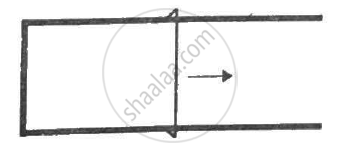
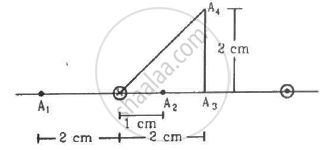
Figure shows two parallel wires separated by a distance of 4.0 cm and carrying equal currents of 10 A along opposite directions. Find the magnitude of the magnetic field B at the points A1, A2, A3.
A long, straight wire carries a current i. Let B1 be the magnetic field at a point P at a distance d from the wire. Consider a section of length l of this wire such that the point P lies on a perpendicular bisector of the section B2 be the magnetic field at this point due to this second only. Find the value of d/l so that B2 differs from B1 by 1%.
According to Ampere's circuital law, ______.
The nature of parallel and anti-parallel currents are ______.
Three infinitely long parallel straight current-carrying wires A, B and C are kept at equal distance from each other as shown in the figure. The wire C experiences net force F. The net force on wire C, when the current in wire A is reversed will be ______.

Do magnetic forces obey Newton’s third law. Verify for two current elements dl1 = dlî located at the origin and dl2 = dlĵ located at (0, R, 0). Both carry current I.
Two long straight parallel current-carrying conductors are kept ‘a’ distant apart in the air. The direction of current in both the conductors is the same. Find the magnitude of force per unit length and the direction of the force between them. Hence define one ampere.
Two long, straight, parallel conductors carry currents flowing in opposite directions (antiparallel currents). The magnetic force between them is:
Which set of conditions must be satisfied in the definition of the ampere?
By symmetry, the magnetic field of conductor b exerts a force on conductor a. The relationship between the two forces Fba and Fab is:
The SI unit of the force per unit length (F/L) between two parallel current-carrying conductors is:
If the current Ia in conductor a is doubled while Ib and the distance d remain unchanged, the force per unit length F/L between the conductors:
If the perpendicular distance d between two parallel current-carrying conductors is doubled, the force per unit length F/L:
The magnetic force between two long parallel current-carrying conductors acts:
