Advertisements
Advertisements
प्रश्न
Two long, straight wires, each carrying a current of 5 A, are placed along the x- and y-axis respectively. The currents point along the positive directions of the axes. Find the magnetic fields at the points (a) (1 m, 1 m), (b) (−1 m, 1 m), (c) (−1 m, −1 m) and (d) (1 m, −1 m).
Advertisements
उत्तर
Given:
Magnitude of current, I = 5 A
Separation of the point from the wire, d = 1 m
Thus, the magnitude of magnetic field due to current in the wires is given by
\[B_1 = B_2 = \frac{\mu_0 I}{2\pi d}\]
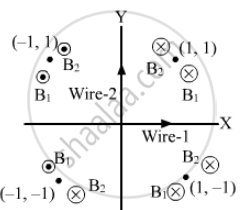
(a) At point (1 m, 1 m), the magnetic fields due to the wires are the same in magnitude, but they are opposite in direction.
Hence, the net magnetic field is zero.
(b) At point (−1 m, 1 m), the magnetic fields due to the wires are in upward direction.
\[\Rightarrow B_{net} = B_1 + B_2 \]
\[ = \left( \frac{2 \times {10}^{- 7} \times 5}{1} + \frac{2 \times {10}^{- 7} \times 5}{1} \right)\]
= 2 × 10⁻⁶ T (Along the z-axis)
(c) At point (−1 m, −1 m), the magnetic fields due to the wires are the same in magnitude, but they are opposite in direction.
Hence, the net magnetic field is zero.
(d) At point (1 m, −1 m), the magnetic fields due to the wires are in upward direction.
\[\Rightarrow B_{net} = B_1 + B_2 \]
\[ = \left( \frac{2 \times {10}^{- 7} \times 5}{1} + \frac{2 \times {10}^{- 7} \times 5}{1} \right)\]
= 2 × 10⁻⁶ T (Along the negative z-axis)
APPEARS IN
संबंधित प्रश्न
The figure shows three infinitely long straight parallel current carrying conductors. Find the
- magnitude and direction of the net magnetic field at point A lying on conductor 1,
- magnetic force on conductor 2.

Two long straight parallel conductors 'a' and 'b', carrying steady currents Ia and Ib are separated by a distance d. Write the magnitude and direction of the magnetic field produced by the conductor 'a' at the points along the conductor 'b'. If the currents are flowing in the same direction, what is the nature and magnitude of the force between the two conductors?
A charged particle goes undeflected in a region containing an electric and a magnetic field. It is possible that
(a) `vecE" || "vecB , vecv" || " vec E `
(b) `vecE "is not parallel" vecB`
(c) `vecv " || " vecB but vecv "is not parallel"`
(d) `vecE" || " vecB but vecv "is not parallel"`
A long, straight wire of radius r carries a current i and is placed horizontally in a uniform magnetic field B pointing vertically upward. The current is uniformly distributed over its cross section. (a) At what points will the resultant magnetic field have maximum magnitude? What will be the maximum magnitude? (b) What will be the minimum magnitude of the resultant magnetic field?
A hypothetical magnetic field existing in a region is given by `vecB = B_0 vece` where `vece`_r denotes the unit vector along the radial direction. A circular loop of radius a, carrying a current i, is placed with its plane parallel to the x−y plane and the centre at (0, 0, d). Find the magnitude of the magnetic force acting on the loop.
A rectangular coil of 100 turns has length 5 cm and width 4 cm. It is placed with its plane parallel to a uniform magnetic field and a current of 2 A is sent through the coil. Find the magnitude of the magnetic field B if the torque acting on the coil is 0.2 N m−1
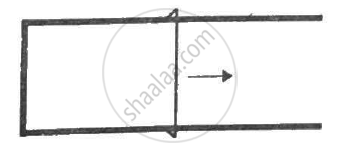
Figure shows a metallic wire of resistance 0.20 Ω sliding on a horizontal, U-shaped metallic rail. The separation between the parallel arms is 20 cm. An electric current of 2.0 µA passes through the wire when it is slid at a rate of 20 cm s−1. If the horizontal component of the earth's magnetic field is 3.0 × 10⁻⁵ T, calculate the dip at the place.
Two parallel wires carry equal currents of 10 A along the same direction and are separated by a distance of 2.0 cm. Find the magnetic field at a point which is 2.0 cm away from each of these wires.
Three coplanar parallel wires, each carrying a current of 10 A along the same direction, are placed with a separation 5.0 cm between the consecutive ones. Find the magnitude of the magnetic force per unit length acting on the wires.
Two parallel wires separated by a distance of 10 cm carry currents of 10 A and 40 A along the same direction. Where should a third current by placed so that it experiences no magnetic force?
Define Ampere in terms of force between two current carrying conductors.
If a current I is flowing in a straight wire parallel to x-axis and magnetic field is there in the y-axis then, ______.
Do magnetic forces obey Newton’s third law. Verify for two current elements dl1 = dlî located at the origin and dl2 = dlĵ located at (0, R, 0). Both carry current I.
The force per unit length between two long parallel current-carrying conductors carrying currents I₁ and I₂, separated by a perpendicular distance d, is given by:
The SI unit of the force per unit length (F/L) between two parallel current-carrying conductors is:
If the current Ia in conductor a is doubled while Ib and the distance d remain unchanged, the force per unit length F/L between the conductors:
If the perpendicular distance d between two parallel current-carrying conductors is doubled, the force per unit length F/L:
