Advertisements
Advertisements
प्रश्न
The magnetic field existing in a region is given by `vecB = B_0(1 + x/1)veck` . A square loop of edge l and carrying a current i, is placed with its edges parallel to the x−y axes. Find the magnitude of the net magnetic force experienced by the loop.
Advertisements
उत्तर
Given:
Magnetic field, `vecB = B_0(1 + x/1)veck`
Length of the edge of a square loop = l
Electric current flowing through it = i
As per the question, the loop is placed with its edges parallel to the X−Y axes.
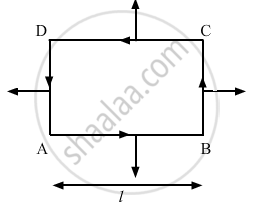
In the figure, arrow denotes the direction of force on different sides of the square.
The net magnetic force experienced by the loop,
`vecF = ivecl xx vecB`
Force on AB:
Consider a small element of length dx at a distance x from the origin on line AB.
Force on this small element,
dF = iB_0 on the full length of AB,
FAB = \[\int\limits_{x=0}^{x=0}\] iB_0 `(1 + x/l)`
= `iB_0` \[\int\limits_{x=0}^{x=0}\] `(dx + 1/l xdx)`
= `iB_0(l + 1/2)`
= `(3iBgl)/(2)`
Force on AB will be acting downwards.
Similarly, force on CD,
`F_2 = iB_0 (l + l/2)`
`=(3iBgl)/(2)`
Force on AB will be acting downwards.
Similarly, force on CD,
`F_2 = iB_0 (l + 1/2)`
= `(3iBgl)/2`
So, the net vertical force = F1 − F2 = 0
Force on AD,
`F_4 = iB_0l (1 + 1/l)`
= 2iB0l
Force on BC
`F_4 = iB_0l(1 + 1/l)`
=2iB0l
So, the net horizontal force = F4−F3 = iB0l
APPEARS IN
संबंधित प्रश्न
A charged particle goes undeflected in a region containing an electric and a magnetic field. It is possible that
(a) `vecE" || "vecB , vecv" || " vec E `
(b) `vecE "is not parallel" vecB`
(c) `vecv " || " vecB but vecv "is not parallel"`
(d) `vecE" || " vecB but vecv "is not parallel"`
A long, straight wire carries a current along the z-axis, One can find two points in the x−y plane such that
(a) the magnetic fields are equal
(b) the directions of the magnetic fields are the same
(c) the magnitudes of the magnetic fields are equal
(d) the field at one point is opposite to that at the other point.
A current of 10 A is established in a long wire along the positive z-axis. Find the magnetic field \[\vec{B}\] at the point (1 m, 0, 0).
A long, straight wire of radius r carries a current i and is placed horizontally in a uniform magnetic field B pointing vertically upward. The current is uniformly distributed over its cross section. (a) At what points will the resultant magnetic field have maximum magnitude? What will be the maximum magnitude? (b) What will be the minimum magnitude of the resultant magnetic field?
A long, straight wire carries a current i. Let B1 be the magnetic field at a point P at a distance d from the wire. Consider a section of length l of this wire such that the point P lies on a perpendicular bisector of the section B2 be the magnetic field at this point due to this second only. Find the value of d/l so that B2 differs from B1 by 1%.
A straight, how wire carries a current of 20 A. Another wire carrying equal current is placed parallel to it. If the force acting on a length of 10 cm of the second wire is 2.0 × 10⁻⁵ N, what is the separation between them?
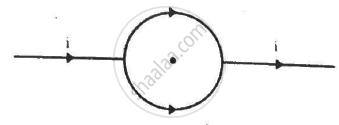
A conducting circular loop of radius a is connected to two long, straight wires. The straight wires carry a current i as shown in figure. Find the magnetic field B at the centre of the loop.
Define Ampere in terms of force between two current carrying conductors.
Five long wires A, B, C, D and E, each carrying current I are arranged to form edges of a pentagonal prism as shown in figure. Each carries current out of the plane of paper.

- What will be magnetic induction at a point on the axis O? AxisE is at a distance R from each wire.
- What will be the field if current in one of the wires (say A) is switched off?
- What if current in one of the wire (say) A is reversed?
Beams of electrons and protons move parallel to each other in the same direction. They ______.
Two long parallel wires kept 2 m apart carry 3A current each, in the same direction. The force per unit length on one wire due to the other is ______.
The figure below are two long, parallel wires carrying current in the same direction such that I1 < I2.

- In which direction will wire I1 move?
- If the direction of the current I2 is reversed, in which direction will the wire I1 move now?
Two long, straight, parallel conductors carry currents flowing in opposite directions (antiparallel currents). The magnetic force between them is:
The SI unit of the permeability of free space (μ₀) is:
The SI unit of the force per unit length (F/L) between two parallel current-carrying conductors is:
A wire carrying a current of 1 A flows East → West in a region where the horizontal component of Earth's magnetic field is B = 3.0 × 10⁻⁵ T directed South → North. The force per unit length on the wire is:
