Advertisements
Advertisements
Question
Using the concept of force between two infinitely long parallel current carrying conductors, define one ampere of current.
Advertisements
Solution
One ampere of current can be defined as the amount of current which when flowing (in same direction) through two infinitely long parallel wires separated by one metre produces an attractive force of 2 × 10⁻⁷ N/m. The wires must have negligible circular cross-section and they must be placed in vacuum.
APPEARS IN
RELATED QUESTIONS
Two long and parallel straight wires A and B carrying currents of 8.0 A and 5.0 A in the same direction are separated by a distance of 4.0 cm. Estimate the force on a 10 cm section of wire A.
A charged particle goes undeflected in a region containing an electric and a magnetic field. It is possible that
(a) `vecE" || "vecB , vecv" || " vec E `
(b) `vecE "is not parallel" vecB`
(c) `vecv " || " vecB but vecv "is not parallel"`
(d) `vecE" || " vecB but vecv "is not parallel"`
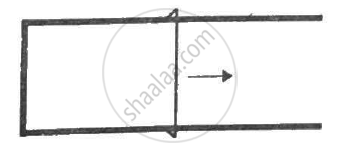
Figure shows a metallic wire of resistance 0.20 Ω sliding on a horizontal, U-shaped metallic rail. The separation between the parallel arms is 20 cm. An electric current of 2.0 µA passes through the wire when it is slid at a rate of 20 cm s−1. If the horizontal component of the earth's magnetic field is 3.0 × 10⁻⁵ T, calculate the dip at the place.
Two parallel wires carry equal currents of 10 A along the same direction and are separated by a distance of 2.0 cm. Find the magnetic field at a point which is 2.0 cm away from each of these wires.
According to Ampere's circuital law, ______.
Two long, straight, parallel conductors carry currents flowing in opposite directions (antiparallel currents). The magnetic force between them is:
A segment of length L of conductor b, carrying current Ib, is placed in the magnetic field Ba produced by conductor a. The force experienced by this segment is known as the:
The SI unit of the permeability of free space (μ₀) is:
The SI unit of the force per unit length (F/L) between two parallel current-carrying conductors is:
