Advertisements
Advertisements
Question
Two long and parallel straight wires A and B carrying currents of 8.0 A and 5.0 A in the same direction are separated by a distance of 4.0 cm. Estimate the force on a 10 cm section of wire A.
Advertisements
Solution
Given: Current flowing in wire A, IA = 8.0 A
Current flowing in wire B, IB = 5.0 A
Distance between the two wires, r = 4.0 cm = 0.04 m
Length of a section of wire A, l = 10 cm = 0.1 m
`mu_0` = Permeability of free space = 4π × 10–7 T m A–1
Formula: B = `(mu_0 2I_AI_BI)/(4pir)`
B = `(4pi xx 10^-7 xx 2 xx 8 xx 5 xx 0.1)/(4pi xx 0.04)`
= `(0.8 xx 10^-7)/0.04`
= 200 × 10–7
= 2 × 10⁻⁵ N
The magnitude of the force is 2 × 10⁻⁵ N. This is an attractive force normal to A towards B because the currents in the wires are in the same direction.
RELATED QUESTIONS
and ```vecE` and `vecB`denote electric and magnetic fields in a frame S and `vecE`→ and `vecB` in another frame S' moving with respect to S at a velocity `vecV` Two of the following equations are wrong. Identify them.
(a) `B_y^, = B_y + (vE_z)/c^2`
(b) `E_y^' = E_y - (vB_z)/(c^2)`
`(c) Ey = By + vE_z`
`(d) E_y = E_y + vB_z`
An electron is moving along the positive x-axis. You want to apply a magnetic field for a short time so that the electron may reverse its direction and move parallel to the negative x-axis. This can be done by applying the magnetic field along
(a) y-axis
(b) z-axis
(c) y-axis only
(d) z-axis only
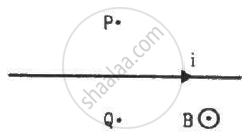
A long, straight wire carrying a current of 1.0 A is placed horizontally in a uniform magnetic field B = 1.0 × 10⁻⁵ T pointing vertically upward figure. Find the magnitude of the resultant magnetic field at the points P and Q, both situated at a distance of 2.0 cm from the wire in the same horizontal plane.
A hypothetical magnetic field existing in a region is given by `vecB = B_0 vece` where `vece`_r denotes the unit vector along the radial direction. A circular loop of radius a, carrying a current i, is placed with its plane parallel to the x−y plane and the centre at (0, 0, d). Find the magnitude of the magnetic force acting on the loop.
A straight wire of length l can slide on two parallel plastic rails kept in a horizontal plane with a separation d. The coefficient of friction between the wire and the rails is µ. If the wire carries a current i, what minimum magnetic field should exist in the space in order to slide the wire on the rails?
The magnetic field existing in a region is given by `vecB = B_0(1 + x/1)veck` . A square loop of edge l and carrying a current i, is placed with its edges parallel to the x−y axes. Find the magnitude of the net magnetic force experienced by the loop.
Consider a 10-cm long piece of a wire which carries a current of 10 A. Find the magnitude of the magnetic field due to the piece at a point which makes an equilateral triangle with the ends of the piece.
A straight, how wire carries a current of 20 A. Another wire carrying equal current is placed parallel to it. If the force acting on a length of 10 cm of the second wire is 2.0 × 10⁻⁵ N, what is the separation between them?
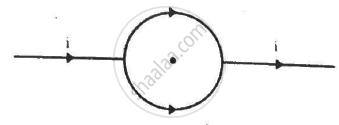
A conducting circular loop of radius a is connected to two long, straight wires. The straight wires carry a current i as shown in figure. Find the magnetic field B at the centre of the loop.
According to Ampere's circuital law, ______.
The nature of parallel and anti-parallel currents are ______.
Three infinitely long parallel straight current-carrying wires A, B and C are kept at equal distance from each other as shown in the figure. The wire C experiences net force F. The net force on wire C, when the current in wire A is reversed will be ______.

Do magnetic forces obey Newton’s third law. Verify for two current elements dl1 = dlî located at the origin and dl2 = dlĵ located at (0, R, 0). Both carry current I.
Five long wires A, B, C, D and E, each carrying current I are arranged to form edges of a pentagonal prism as shown in figure. Each carries current out of the plane of paper.

- What will be magnetic induction at a point on the axis O? AxisE is at a distance R from each wire.
- What will be the field if current in one of the wires (say A) is switched off?
- What if current in one of the wire (say) A is reversed?
Two long parallel wires kept 2 m apart carry 3A current each, in the same direction. The force per unit length on one wire due to the other is ______.
Two long, straight, parallel conductors carry currents flowing in opposite directions (antiparallel currents). The magnetic force between them is:
According to the definition of the ampere, the constant current maintained in each of two infinitely long, straight, parallel conductors of negligible circular cross-section, placed 1 metre apart in a vacuum, produces a force between them equal to:
A segment of length L of conductor b, carrying current Ib, is placed in the magnetic field Ba produced by conductor a. The force experienced by this segment is known as the:
The SI unit of the force per unit length (F/L) between two parallel current-carrying conductors is:
