Advertisements
Advertisements
Question
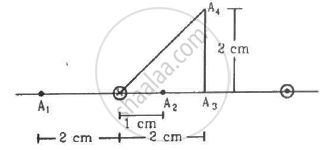
Figure shows two parallel wires separated by a distance of 4.0 cm and carrying equal currents of 10 A along opposite directions. Find the magnitude of the magnetic field B at the points A1, A2, A3.
Advertisements
Solution
For point A1,
Magnitude of current in wires, I = 10 A
Separation of point A1 from the wire on the left side, d = 2 cm
Separation of point A1 from the wire on the right side, d' = 6 cm
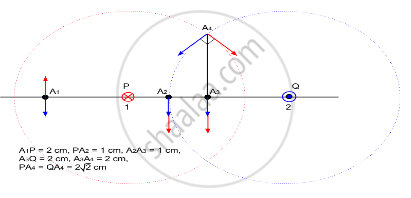
In the figure
Red and blue arrow denotes the direction of magnetic field due to the wire marked as red and blue respectively.
P (marked red) denotes the wire carrying current in a plane going into the paper.
Q (marked blue) denotes the wire carrying current in a plane coming out of the paper.
Also from the figure, we can see that
\[P A_4 = Q A_4 \]
\[\angle A_4 A_3 P = \angle A_4 A_3 Q = 90^\circ \]
\[ \Rightarrow \angle A_4 P A_3 = \angle A_4 Q A_3 = 45^\circ \]
\[ \Rightarrow \angle P A_4 A_3 = \angle Q A_4 A_3 = 45^\circ \]
\[ \Rightarrow \angle P A_4 Q = 90^\circ \]
The magnetic field at A1 due to current in the wires is given by
\[B = \frac{\mu_0 I}{2\pi d} - \frac{\mu_0 I}{2\pi d'}\] ...(1)
\[\Rightarrow B = \frac{2 \times {10}^{- 7} \times 10}{2 \times {10}^{- 2}} - \frac{2 \times {10}^{- 7} \times 10}{6 \times {10}^{- 2}}\]
\[ = \left( 1 - \frac{1}{3} \right) \times {10}^{- 4} \]
\[ = 0 . 67 \times {10}^{- 4} T\]
Similarly, we get the magnetic field at A2 using eq. (1).
\[B = \frac{2 \times {10}^{- 7} \times 10}{1 \times {10}^{- 2}} + \frac{2 \times {10}^{- 7} \times 10}{3 \times {10}^{- 2}}\]
\[ = \frac{8}{3} \times {10}^{- 4} T\]
\[ = 2 . 67 \times {10}^{- 4} T\]
Now,
Magnetic field at A3:
\[B = \frac{2 \times {10}^{- 7} \times 10}{2 \times {10}^{- 2}} + \frac{2 \times {10}^{- 7} \times 10}{2 \times {10}^{- 2}}\]
\[ = 2 \times {10}^{- 4} T\]
Separation of point A4 from the wire on the left side, d = \[\sqrt{2^2 + 2^2} = 2\sqrt{2} \] cm
\[B = \sqrt{\left( \frac{2 \times {10}^{- 7} \times 10}{2\sqrt{2} \times {10}^{- 2}} \right)^2 + \left( \frac{2 \times {10}^{- 7} \times 10}{2\sqrt{2} \times {10}^{- 2}} \right)^2}\]
\[ = 1 \times {10}^{- 4} T\]
APPEARS IN
RELATED QUESTIONS
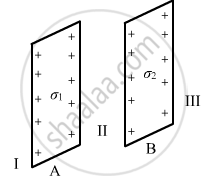
Two infinitely large plane thin parallel sheets having surface charge densities σ1 and σ2 (σ1 > σ2) are shown in the figure. Write the magnitudes and directions of the net fields in the regions marked II and III.
An electron beam projected along the positive x-axis deflects along the positive y-axis. If this deflection is caused by a magnetic field, what is the direction of the field? Can we conclude that the field is parallel to the z-axis?
A charged particle goes undeflected in a region containing an electric and a magnetic field. It is possible that
(a) `vecE" || "vecB , vecv" || " vec E `
(b) `vecE "is not parallel" vecB`
(c) `vecv " || " vecB but vecv "is not parallel"`
(d) `vecE" || " vecB but vecv "is not parallel"`
Two parallel, long wires carry currents i1 and i2 with i1 > i2. When the currents are in the same direction, the magnetic field at a point midway between the wires is 10 µT. If the direction of i2 is reversed, the field becomes 30 µT. The ratio i1/i2 is
A long, straight wire carries a current along the z-axis, One can find two points in the x−y plane such that
(a) the magnetic fields are equal
(b) the directions of the magnetic fields are the same
(c) the magnitudes of the magnetic fields are equal
(d) the field at one point is opposite to that at the other point.
A transmission wire carries a current of 100 A. What would be the magnetic field B at a point on the road if the wire is 8 m above the road?
A hypothetical magnetic field existing in a region is given by `vecB = B_0 vece` where `vece`_r denotes the unit vector along the radial direction. A circular loop of radius a, carrying a current i, is placed with its plane parallel to the x−y plane and the centre at (0, 0, d). Find the magnitude of the magnetic force acting on the loop.
Two long, straight wires, each carrying a current of 5 A, are placed along the x- and y-axis respectively. The currents point along the positive directions of the axes. Find the magnetic fields at the points (a) (1 m, 1 m), (b) (−1 m, 1 m), (c) (−1 m, −1 m) and (d) (1 m, −1 m).
Define Ampere in terms of force between two current carrying conductors.
If a current I is flowing in a straight wire parallel to x-axis and magnetic field is there in the y-axis then, ______.
A milli voltmeter of 25 milli volt range is to be converted into an ammeter of 25 ampere range. The value (in ohm) of necessary shunt will be ______.
Three infinitely long parallel straight current-carrying wires A, B and C are kept at equal distance from each other as shown in the figure. The wire C experiences net force F. The net force on wire C, when the current in wire A is reversed will be ______.

The figure below are two long, parallel wires carrying current in the same direction such that I1 < I2.

- In which direction will wire I1 move?
- If the direction of the current I2 is reversed, in which direction will the wire I1 move now?
Which set of conditions must be satisfied in the definition of the ampere?
By symmetry, the magnetic field of conductor b exerts a force on conductor a. The relationship between the two forces Fba and Fab is:
If the current Ia in conductor a is doubled while Ib and the distance d remain unchanged, the force per unit length F/L between the conductors:
The magnetic force between two long parallel current-carrying conductors acts:
A wire carrying a current of 1 A flows East → West in a region where the horizontal component of Earth's magnetic field is B = 3.0 × 10⁻⁵ T directed South → North. The force per unit length on the wire is:
