Advertisements
Advertisements
Question
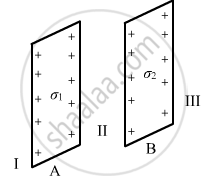
Two infinitely large plane thin parallel sheets having surface charge densities σ1 and σ2 (σ1 > σ2) are shown in the figure. Write the magnitudes and directions of the net fields in the regions marked II and III.
Advertisements
Solution

In region II
The electric field due to the sheet of charge A will be from left to right (along the positive direction) and that due to the sheet of charge B will be from right to left (along the negative direction). Therefore, on region II, we have:
\[E = \frac{\sigma_1}{\epsilon_0} + \left( - \frac{\sigma_2}{\epsilon_0} \right)\]
\[ \Rightarrow E = \frac{1}{\epsilon_0}\left( \sigma_1 - \sigma_2 \right)\]
In region III
The electric fields due to both the charged sheets will be from left to right, i.e., along the positive direction. Therefore, in region III, we have:
\[E = \frac{\sigma_1}{\epsilon_0} + \frac{\sigma_2}{\epsilon_0}\]
\[ \Rightarrow E = \frac{1}{\epsilon_0}\left( \sigma_1 + \sigma_2 \right)\]
RELATED QUESTIONS
Using the concept of force between two infinitely long parallel current carrying conductors, define one ampere of current.
and ```vecE` and `vecB`denote electric and magnetic fields in a frame S and `vecE`→ and `vecB` in another frame S' moving with respect to S at a velocity `vecV` Two of the following equations are wrong. Identify them.
(a) `B_y^, = B_y + (vE_z)/c^2`
(b) `E_y^' = E_y - (vB_z)/(c^2)`
`(c) Ey = By + vE_z`
`(d) E_y = E_y + vB_z`
A transmission wire carries a current of 100 A. What would be the magnetic field B at a point on the road if the wire is 8 m above the road?
A hypothetical magnetic field existing in a region is given by `vecB = B_0 vece` where `vece`_r denotes the unit vector along the radial direction. A circular loop of radius a, carrying a current i, is placed with its plane parallel to the x−y plane and the centre at (0, 0, d). Find the magnitude of the magnetic force acting on the loop.
A rectangular coil of 100 turns has length 5 cm and width 4 cm. It is placed with its plane parallel to a uniform magnetic field and a current of 2 A is sent through the coil. Find the magnitude of the magnetic field B if the torque acting on the coil is 0.2 N m−1
Do magnetic forces obey Newton’s third law. Verify for two current elements dl1 = dlî located at the origin and dl2 = dlĵ located at (0, R, 0). Both carry current I.
Two long straight parallel current-carrying conductors are kept ‘a’ distant apart in the air. The direction of current in both the conductors is the same. Find the magnitude of force per unit length and the direction of the force between them. Hence define one ampere.
Two long, straight, parallel conductors carry currents flowing in opposite directions (antiparallel currents). The magnetic force between them is:
A segment of length L of conductor b, carrying current Ib, is placed in the magnetic field Ba produced by conductor a. The force experienced by this segment is known as the:
