Advertisements
Chapters
2: Motion in One Dimension
3: Laws of Motion
Chapter 4: Pressure in Fluids and its Transmission
5: Upthrust in Fluids, Archimedes’ Principle and Floatation
6: Heat and Energy
7: Reflection of Light
8: Propagation of Sound Waves
9: Current Electricity
10: Magnetism
![Selina solutions for Concise Physics [English] Class 9 ICSE chapter 1 - Measurements and Experimentation - Shaalaa.com](/images/concise-physics-english-class-9-icse_6:07d58a5ba3504cd1865aa94a55b34e1a.jpg "Selina solutions for Concise Physics [English] Class 9 ICSE chapter 1 - Measurements and Experimentation")
Advertisements
Solutions for Chapter 1: Measurements and Experimentation
Below listed, you can find solutions for Chapter 1 of CISCE Selina for Concise Physics [English] Class 9 ICSE.
Selina solutions for Concise Physics [English] Class 9 ICSE 1 Measurements and Experimentation Exercise 1 (A) [Page 9]
What is meant by measurement?
What do you understand by the Term Unit?
What are the three requirements for selecting a unit of a physical quantity?
Name the three fundamental quantities.
Name the three systems of units and state the various fundamentals units in them.
Define a fundamental unit.
What are the fundamental unit in S.I system? Name them along with their symbols.
Explain the meaning of the derived unit with the help of one example?
Define Standard metre.
Name two units of length which are bigger than a metre. How are they related of the metre?
Write the names of two units of length smaller than a metre. Express their relationship with the metre.
How is nanometer related to Angstrom?
Name the three convenient units used to measure length ranging from very short to very long value. How are they related to the S.I unit?
Name the S.I unit of mass and define it.
Complete the following: 1 light year =……….m
Complete the following: 1 m =……….Å
Complete the following: 1 m =……….. µ
Complete the following: 1 micron =………..Å
Complete the following: 1 fermi = ……….. m
State two units of mass smaller than a kilogram. How are they related to kilogram?
State two units of mass bigger than a kilogram. Give their relationship with the kilogram?
Complete the following: 1 g =………kg
Complete the following : 1 mg =………kg
Complete the following: 1 quintal =………kg
Complete the following : 1 a.m.u (or u) =……..kg
Name the S.I unit of time and define it.
Name two units of time bigger than a second. How are they related to the Second?
What is a leap year?
The year 2020 will have February of 29 days'. Is this statement true?
What is a lunar month?
Complete the following: 1 nano second =……….s.
Complete the following: 1 µs =……….s
Complete the following:
1 mean solar day = _______ s.
Complete the following: 1 year =……….s.
Name the physical quantities which are measured in the given units: u
Name the physical quantities which are measured in the given units:-
ly
Name the physical quantities which are measured in the given units:-
ns
Name the physical quantities which are measured in the given units:
nm
Write the derived unit of speed
Write the derived unit of force
Write the derived unit of work
Write the derived unit of the pressure
How are the following derived unit related to the fundamental unit?
Newton
How are the following derived unit related to the fundamental unit?
watt
How are the followings derived unit related to the fundamental unit?
joule
How are the following derived unit related to the fundamental unit?
Pascal
Name the physical quantity related to the following unit :-
km2
Name the physical quantity related to the following unit:-
Newton
Name the physical quantity related to the following unit :- Joule
Name the physical quantity related to the following unit: Pascal
Name the physical quantity related to the following unit:- watt
Selina solutions for Concise Physics [English] Class 9 ICSE 1 Measurements and Experimentation Exercise 1 (A) [Page 10]
The fundamental unit is:-
Newton
Pascal
hertz
second
Which of the following unit is not a fundamental unit:
metre
Litre
second
kilogram
The unit of time is :
light year
parsec
leap year
angstrom
1 Å is equal to :
0.1 nm
10-10 cm
10-8 m
104 µ
ly is the unit of:-
time
length
mass
none of this
Selina solutions for Concise Physics [English] Class 9 ICSE 1 Measurements and Experimentation Exercise 1 (A) [Page 10]
The wavelength of light of a particular colour is 5800 Å.
Express it in nanometre.
The wavelength of light of a particular colour is 5800 Å.
Express it in metre.
The size of bacteria is 1 µ. Find the number of bacteria present in 1 m length.
The distance of a galaxy is 5·6 × 1025 m . Assuming the speed of light to be 3 × 10⁸ `"ms"^-1`. Find the time taken by light to travel this distance .
[Hint : `"Time taken" = "Distance travelled"/"speed"`]
The wavelength of light is 589 nm. what is its wavelength in Å?
The mass of an oxygen atom is 16.0 u. Express it in kg.
It takes time 8 min for light to reach from the sun to the earth surface . If speed of light is taken to be `3 xx 10^8 "m/s"^-1` , find the distance from the sun to the earth in km .
‘The distance of a star from the earth is 8.33 light minutes.’ What do you mean by this statement? Express the distance in metre.
Selina solutions for Concise Physics [English] Class 9 ICSE 1 Measurements and Experimentation Exercise 1 (B) [Page 20]
Explain the meaning of the term 'least count of an instrument' by taking a suitable example.
A boy makes a ruler with graduations in cm on it, (i.e. 100 divisions in 1 m). To what accuracy this ruler can measure? How can this accuracy be increased?
A boy measures the length of a pencil and expresses it to be 2.6 cm. what is the accuracy of his measurement? Can he write it as 2.60 cm?
Define the least count of vernier callipers. How do you determine it?
Define the term 'Vernier constant'.
When is a vernier Callipers said to be free from zero error?
What is meant by zero error of vernier callipers ? How is it determined? Draw neat diagrams to explain it. How is it taken in account to get the correct measurement?
A vernier callipers has a zero error of + 0.06 cm. Draw a neat labelled diagram to represent it.
Draw a neat and labelled diagram of a vernier callipers. Name its main parts and state their functions.
State three uses of the vernier callipers.
Name the two scales of a vernier callipers and explain how it is used to measure length correct up to 0.01 cm.
Describe in steps, how would you use a vernier callipers to measure the length of a small rod?
Name the part of the vernier callipers which is used to measure the following
External diameter of a tube
Name the part of the vernier callipers which is used to measure the following
Internal diameter of a mug
Name the part of the vernier callipers which is used to measure the following
Depth of a small bottle
Name the part of the vernier callipers which is used to measure the following
Thickness of a pencil.
Explain the terms : Pitch .
How are they determined?
Explain the terms : Least count of a screw gauge.
How are they determined?
How can the least count of a screw gauge be decreased?
Draw a neat and labelled diagram of a screw gauge.
Name its main parts and state their functions.
State one use of a screw gauge.
State the purpose of ratchet in a screw gauge.
What do you mean by zero error of a screw gauge? How is it accounted for?
A screw gauge has a least count 0.001 cm and zero error +0.007 cm. Draw a neat diagram to represent it.
What is backlash error? Why is it caused? How is it avoided?
Describe the procedure to measure the diameter of a wire with the help of a screw gauge.
Name the instrument which can accurately measure the following
The diameter of a needle
Name the instrument which can accurately measure the following
The thickness of a paper
Name the instrument which can accurately measure the following
The internal diameter of the neck of a water bottle
Name the instrument which can accurately measure the following.
The diameter of a pencil.
Which of the following measures a small length to high accuracy : metre rule , vernier callipers or screw gauge?
Name the instrument which has the least count
0.1 mm
Name the instrument which has the least count
1 mm
Name the instrument which has the least count
0.01 mm
Selina solutions for Concise Physics [English] Class 9 ICSE 1 Measurements and Experimentation Exercise 1 (B) [Page 20]
The least count of a vernier calipers is :
1 cm
0.001 cm
0.1 cm
0.01 cm
A microscope has its main scale with 20 divisions in 1 cm and vernier scale with 25 divisions, the length of which is equal to the length of 24 divisions of main scale. The least count of microscope is
0.002 cm
0.001 cm
0.02 cm
0.01 cm
The diameter of a thin wire can be measured by
A vernier calipers
A metre rule
A screw gauge
none of these
Selina solutions for Concise Physics [English] Class 9 ICSE 1 Measurements and Experimentation Exercise 1 (B) [Pages 20 - 21]
A stopwatch has 10 divisions graduated between the 0 and 5 s marks. What is its least count?
A vernier has 10 divisions and they are equal to 9 divisions of the main scale in length. If the main scale is calibrated in mm, what is its least count?
A microscope is provided with a main scale graduated with 20 divisions in 1 cm and a vernier scale with 50 division on it of length same as of 49 divisions of main scale. Find the least count of the microscope.
A boy uses a vernier callipers to measure the thickness of his pencil. He measures it to be 1.4 mm. If the zero error of vernier callipers is +0.02 cm, what is the correct thickness of the pencil?
A vernier callipers has its main scale graduated in mm and 10 divisions on its vernier scale are equal in length to 9 mm. When the two jaws are in contact, the zero of the vernier scale is ahead of the zero of the main scale and the 3rd division of the vernier
scale coincides with a main scale division.
Find : (i) The least count and
(ii) The zero error of the vernier callipers.
The main scale of a vernier callipers is calibrated in mm and 19 divisions of main scale are equal in length to 20 divisions of the vernier scale. In measuring the diameter of a cylinder by this instrument, the main scale reads 35 divisions and 4th division of vernier scale coincides with a main scale division. Find
(i) Least count and (ii) Radius of a cylinder.
In the vernier callipers, there are 10 divisions on the vernier scale and 1 cm on the main scale is divided into 10 parts. While measuring the length, the zero of the vernier lies just ahead of the 1.8 cm mark and the 4th division of vernier coincides with a main scale division.
(a) Find the length.
(b) If zero error of vernier callipers is -0.02 cm,
What is the correct length ?
While measuring the length of a rod with a vernier callipers, below shows the position of its scales. What is the length of the rod?

The pitch of a screw gauge is 0.5 mm and the head scale is divided in 100 parts. What is the least count of a screw gauge?
The thimble of a screw gauge has 50 divisions. The spindle advances 1 mm when the screw is turned through two revolutions.
(i) What is the pitch of the screw gauge?
(ii) What is the least count of the screw gauge?
The pitch of a screw gauge is 1 mm and the circular scale has 100 divisions. In measurement of the diameter of a wire, the main scale reads 2 mm and 45th mark on the circular scale coincides with the base line. Find
(i) The least count and
(ii) The diameter of the wire.
When a screw gauge with a least count of 0.01 mm is used to measure the diameter of a wire, the reading on the sleeve is found to be 1 mm and the reading on the thimble is found to be 27 divisions.
(i) What is the diameter of the wire in cm?
(ii) If the zero error is +0.005 cm, what is the correct diameter?
A screw gauge has 50 divisions on its circular scale and its screw moves by 1 mm on turning it by two revolutions. When the flat end of the screw is in contact with the stud, the zero of the circular scale lies below the base line and 4th division of the circular scale is in line with the base line. Find
(i) The pitch,
(ii) The least count and
(iii) The zero error of the screw gauge
Fig., below shows the reading obtained while measuring the diameter of a wire with a screw gauge. The screw advances by 1 division on the main scale when circular head is rotated once.
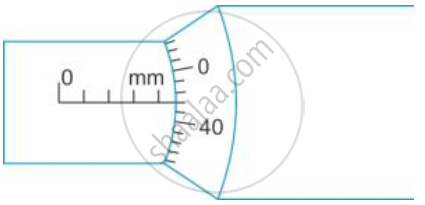 Find:
Find:
(i) Pitch of the screw gauge,
(ii) Least count of the screw gauge and
(iii) The diameter of the wire.
A screw has a pitch equal to 0.5 mm. What should be the number of divisions on its head so as to read correctly up to 0.001 mm with its help?
Selina solutions for Concise Physics [English] Class 9 ICSE 1 Measurements and Experimentation Exercise 1 (C) [Page 25]
What is a simple pendulum? Is the pendulum used in a pendulum clock simple pendulum? Give reason to your answer.
Define the terms : oscillation
What do you understand by amplitude of simple pendulum?
Define the following term:
Frequency
Define the terms : time period as related to a simple pendulum.
Draw a neat diagram of a simple pendulum. Show on it the effective length of the pendulum and its one oscillation .
Name two factors on which the time period of a simple pendulum depends. Write the relation for the time period in terms of the above named factors.
Name two factors on which the time period of a simple pendulum does not depend.
How is the time period of a simple pendulum affected, if at all, in the following situations:
- The length is made four times.
- The acceleration due to gravity is reduced to one-fourth.
How are the time period T and frequency f of an oscillation of a simple pendulum related ?
How do you measure the time period of a given pendulum? Why do you note the time for more than one oscillation?
How does the time period (T) of a simple pendulum depend on its length (l)? Draw a graph showing the variation of T2 with l. How will you use this graph to determine the value of g (acceleration due to gravity)?
Two simple pendulums A and B have equal lengths, but their bobs weigh 50 gf and 100 gf, respectively. What would be the ratio of their time periods? Give reasons for your answer.
Two simple pendulums A and B have lengths 1.0 m and 4.0 m, respectively, at a certain place. Which pendulum will make more oscillations in 1 min? Explain your answer.
State how does the time period of a simple pendulum depend on (a) length of pendulum, (b) mass of bob, (c) amplitude of oscillation and (d) acceleration due to gravity.
What is a second's pendulum?
State the numerical value of the frequency of oscillation of a second's pendulum. Does it depend on the amplitude of oscillations?
Selina solutions for Concise Physics [English] Class 9 ICSE 1 Measurements and Experimentation Exercise 1 (C) [Page 25]
If the length of a simple pendulum is made one-fourth, then its time period becomes
Four times
One-fourth
Double
Half
The time period of a pendulum clock is :
1 s
2 s
1 min
12 h
The length of a second's pedulum is nearly :
0.5 m
9.8 m
1.0 m
2.0 m
Selina solutions for Concise Physics [English] Class 9 ICSE 1 Measurements and Experimentation Exercise 1 (C) [Pages 25 - 26]
A simple pendulum completes 40 oscillations in one minute. Find its (a) Frequency and (b) Time period.
The time period of a simple pendulum is 2 s. What is its frequency? What name is given to such a pendulum?
A seconds pendulum is taken to a place where acceleration due to the gravity falls to one-fourth. How is the time period of the pendulum affected, if at all? Give reasons. What will be its new time period?
Find the length of a second's pendulum at a place where g = 10 m s-2 (Take π = 3.14)
Compare the time periods of the two pendulums of lengths 1 m and 9 m.
A pendulum completes 2 oscillations in 5 s. What is its time period? If g = 9.8 m s-2, find its length.
The time periods of two simple pendulums at a place are in the ratio 2:1. What will be the corresponding ratio of their lengths?
It takes 0.2 s for a pendulum bob to move from the mean position to one end. What is the time period of the pendulum?
How much time does the bob of a second’s pendulum take to move from one extreme of its oscillation to the other extreme?
Solutions for 1: Measurements and Experimentation
Selina solutions for Concise Physics [English] Class 9 ICSE chapter 1 - Measurements and Experimentation
Shaalaa.com has the CISCE Mathematics Concise Physics [English] Class 9 ICSE CISCE solutions in a manner that help students grasp basic concepts better and faster. The detailed, step-by-step solutions will help you understand the concepts better and clarify any confusion. Selina solutions for Mathematics Concise Physics [English] Class 9 ICSE CISCE 1 (Measurements and Experimentation) include all questions with answers and detailed explanations. This will clear students' doubts about questions and improve their application skills while preparing for board exams.
Further, we at Shaalaa.com provide such solutions so students can prepare for written exams. Selina textbook solutions can be a core help for self-study and provide excellent self-help guidance for students.
Concepts covered in Concise Physics [English] Class 9 ICSE chapter 1 Measurements and Experimentation are Unit Systems, Vernier Callipers, Measurements Using Common Instruments, The International System of Units (SI), Simple Pendulum, Measurements, Physical Quantities, Unit and Its Types, Unit Prefixes, Measuring Smaller Distances, Measuring Larger Distances, Rules and Conventions for Writing SI Units and Their Symbols, Principle of Vernier, Screw Gauge, Principle of Screw Gauge, A Time Period of Oscillation and Frequency, Measurement of Length, Measurement of Time, Unit Systems, Vernier Callipers, Measurements Using Common Instruments, The International System of Units (SI), Simple Pendulum, Measurements, Physical Quantities, Unit and Its Types, Unit Prefixes, Measuring Smaller Distances, Measuring Larger Distances, Rules and Conventions for Writing SI Units and Their Symbols, Principle of Vernier, Screw Gauge, Principle of Screw Gauge, A Time Period of Oscillation and Frequency, Measurement of Length, Measurement of Time.
Using Selina Concise Physics [English] Class 9 ICSE solutions Measurements and Experimentation exercise by students is an easy way to prepare for the exams, as they involve solutions arranged chapter-wise and also page-wise. The questions involved in Selina Solutions are essential questions that can be asked in the final exam. Maximum CISCE Concise Physics [English] Class 9 ICSE students prefer Selina Textbook Solutions to score more in exams.
Get the free view of Chapter 1, Measurements and Experimentation Concise Physics [English] Class 9 ICSE additional questions for Mathematics Concise Physics [English] Class 9 ICSE CISCE, and you can use Shaalaa.com to keep it handy for your exam preparation.
