Advertisements
Advertisements
Question
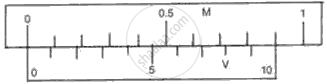
Draw a neat and labelled diagram of a screw gauge.
Name its main parts and state their functions.
Advertisements
Solution
Diagram of screw gauge:

Main parts and their functions:
- Ratchet:It advances the screw by turning it until the object is gently held between the stud and spindle of screw.
- Sleeve:It marks the main scale and base line.
- Thimble:It marks the circular scale.
- Main scale:It helps to read the length correct up to 1 mm.
- Circular scale:It helps to read length correct up to 0.01 mm.
APPEARS IN
RELATED QUESTIONS
When is a vernier Callipers said to be free from zero error?
Describe in steps, how would you use a vernier callipers to measure the length of a small rod?
(a) A vernier scale has 20 divisions. It slides over the main scale, whose pitch is 0.5 mm. If the number of divisions on the left hand of the zero of vernier on the main scale is 38 and the 18th vernier scale division coincides with the main scale, calculate the diameter of the sphere, held in the jaws of vernier callipers.
(b) If the vernier has a negative error of 0.04 cm, calculate the corrected radius of the sphere.
When does a vernier callipers has the positive error?
State whether the following statement is true or false by writing T/F against it.
A metre scale can measure a length of 6.346 cm.
Consider the following case where the zero of vernier scale and the zero of the main scale are clearly seen. If L.C. of the vernier calipers is 0.01 cm, write the zero error and zero correction of the following.
The main scale reading while measuring the thickness of a rubber ball using Vernier caliper is 7 cm and the Vernier scale coincidence is 6. Find the radius of the ball.
