Advertisements
Advertisements
Question
A vernier callipers has its main scale graduated in mm and 10 divisions on its vernier scale are equal in length to 9 mm. When the two jaws are in contact, the zero of the vernier scale is ahead of the zero of the main scale and the 3rd division of the vernier
scale coincides with a main scale division.
Find : (i) The least count and
(ii) The zero error of the vernier callipers.
Advertisements
Solution
(i) Value of 1 m.s.d. =1 mm
10 vernier divisions = 9 m.s.d.
L.C. = Value of 1 m.s.d./number of divisions on the vernier scale
= 1 mm/10
= 0.1 mm or 0.01 cm
(ii) On bringing the jaws together, the zero of the vernier scale is ahead of zero of the main scale, the error is positive.
3rd vernier division coincides with a main scale division.
Total no. of vernier divisions = 10
Zero error = +3 × L.C.
= +3 × 0.01 cm
= +0.03 cm
APPEARS IN
RELATED QUESTIONS
Name the part of the vernier callipers which is used to measure the following
Thickness of a pencil.
What do you mean by zero error of a screw gauge? How is it accounted for?
A pendulum completes 2 oscillations in 5 s. What is its time period? If g = 9.8 m s-2, find its length.
Is it possible to increase the degree of accuracy by mathematical manipulations? Support your answer by an example.
The main scale of vernier callipers has 10 divisions in a centimetre and 10 vernier scale divisions coincide with 9 main scale divisions. Calculate
- pitch
- L.C. of vernier callipers.
Figure shows the position of vernier scale while measuring the external length of a wooden cylinder.
- What is the length recorded by the main scale?
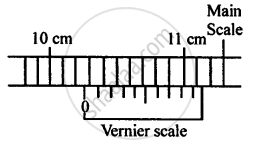
- Which reading of vernier scale coincides with the main scale?
- Calculate the length.
Who invented vernier callipers?
What is the least count in the case of the following instrument?
Spring balance
Define the least count of an instrument.
