Advertisements
Advertisements
Question
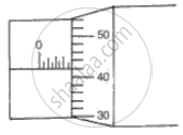
A micrometre screw gauge has a negative zero error of 7 divisions. While measuring the diameter of a wire the reading on the main scale is 2 divisions and 79th circular scale division coincides with baseline.
If the number of divisions on the main scale is 10 to a centimetre and circular scale has 100 divisions, calculate
- pitch
- observed diameter
- least count
- corrected diameter.
Advertisements
Solution
(1) The number of divisions on the main scale are 10 to a centimetre
⇒ Pitch = `"Unit"/"No. of divisions in unit"=(1 "cm")/10` = 0.1 cm
(2) No. of circular scale divisions = 100
∴ Least count (L.C.) = `"Pitch"/"No. of circular scale divisions"`
= `0.1/100` cm
= 0.001 cm
(3) Main scale reading = 2 division
⇒ Main scale reading = 2 × Pitch = 0.2 cm
Circular scale reading = 79 division
∴ Observed diametre = M.S. reading + L.C. × C.S. reading
= 0.2 + 0.001 × 79
= 0.2 + 0.079 cm
= 0.279 cm
(4) Negative zero error = 7 division
∴ Correct = −(−7 × L.C.)
= −(−7 × 0.001) cm
= +0.007 cm
Correct diametre = Observed diametre + Correction
= 0.279 + 0.007
= 0.286 cm
APPEARS IN
RELATED QUESTIONS
Name the instrument which has the least count
0.1 mm
A boy uses a vernier callipers to measure the thickness of his pencil. He measures it to be 1.4 mm. If the zero error of vernier callipers is +0.02 cm, what is the correct thickness of the pencil?
Is it possible to increase the degree of accuracy by mathematical manipulations? Support your answer by an example.
The final result of the calculation in an experiment is 125,347,200. Express the number in term of significant place when accuracy is between 1 and 100
What do you understand by the following term as applied to micrometre screw gauge?
Baseline
What is meant by the pitch of a screw gauge? The pitch of a screw is 1 mm.
Find the reading of the instrument shown in the following figure.