English

How does negative error arise in the instrument?

Advertisements
Advertisements

Question

How does negative error arise in the instrument?
Short/Brief Note
Advertisements

Solution

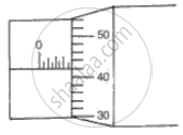
If the zero of the circular scale lies above the line of graduation then it is called negative zero error. When there is a negative zero error, then the instrument reads less than the actual reading. Therefore in order to get the correct reading, the zero error should always be added from the observed reading.
shaalaa.com
  Is there an error in this question or solution?
Chapter 1: Measurements and Experimentation - Exercise 5 [Page 47]

APPEARS IN

Frank Physics Part 1 [English] Class 9 ICSE
Chapter 1 Measurements and Experimentation
Exercise 5 | Q 21 | Page 47

RELATED QUESTIONS

State three uses of the vernier callipers.


Name the two scales of a vernier callipers and explain how it is used to measure length correct up to 0.01 cm.


Explain the terms : Pitch .
How are they determined?


In the vernier callipers, there are 10 divisions on the vernier scale and 1 cm on the main scale is divided into 10 parts. While measuring the length, the zero of the vernier lies just ahead of the 1.8 cm mark and the 4th division of vernier coincides with a main scale division.

(a) Find the length.

(b) If zero error of vernier callipers is -0.02 cm,

What is the correct length ?


The main scale of vernier callipers has 10 divisions in a centimetre and 10 vernier scale divisions coincide with 9 main scale divisions. Calculate

  1. pitch
  2. L.C. of vernier callipers.

A micrometre screw gauge having a positive zero error of 5 divisions is used to measure diameter of a wire, when reading on the main scale is 3rd division and the 48th circular scale division coincides with baseline. If the micrometer has 10 divisions to a centimetre on the main scale and 100 divisions on a circular scale, calculate

  1. Pitch of screw
  2. Least count of screw
  3. Observed diameter
  4. Corrected diameter.

What do you understand by the following term as applied to screw gauge?

Zero error


How does the presentation of data in a tabular form help us in analyzing them? Explain with one example.

If the 47th division of the circular scale coincides with the zero of the main scale of a screw gauge of least count 0.01 mm and having 50 circular divisions, what is it's zero error?

A screw thread has 20 threads in 1 cm and its circular scale has 50 divisions. Calculate its pitch and least count.

Share
Notifications

Englishहिंदीमराठी


      Forgot password?
Use app×