Advertisements
Advertisements
Question
What is meant by the pitch of a screw gauge? The pitch of a screw is 1 mm.
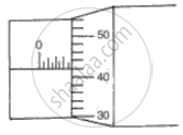
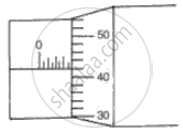
Find the reading of the instrument shown in the following figure.
Advertisements
Solution
When one complete rotation is given to the screw hand, it moves forward or backward by a distance is called the pitch of the screw. It is a distance between two consecutive threads of the screw.
`"Pitch of the screw" = "distance travelled by screw in n rotations"/"n rotations"`
Pitch of the screw = 1 mm
No. of divisions on circular scale = 100
`"Least count" = "pitch"/"no. of divisions"` = 0.01 mm
Main scale reading = 3 mm
Circular scale division coinciding with the main scale = 42
Circular scale reading = 0.01 x 42 = 0.42
Final reading = 3 + 0.42 = 3.42 mm
APPEARS IN
RELATED QUESTIONS
A pendulum completes 2 oscillations in 5 s. What is its time period? If g = 9.8 m s-2, find its length.
How can the least count of a screw gauge be decreased?
State the formula for calculating length if:
The reading of the main scale is known and the number of vernier scale divisions coinciding with the main scale is known.
What do you understand by the following term as applied to screw gauge?
Positive zero error
How do you account for positive zero error for calculating the correct diameter of wires?
What is the backlash error?
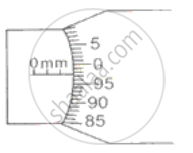
In the following figure, the pitch of the screw is 1 mm. Calculate:
(i) the least count of screw gauge and
(ii) the reading represented in the figure.
Define the least count of an instrument.
A Vernier calliper reads a main scale reading of 2.3 cm and the 5th division of the Vernier scale coincides with a main scale division. If the least count is 0.01 cm, what is the actual reading?
