Advertisements
Advertisements
Question
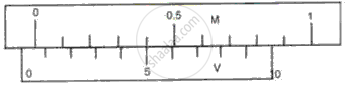
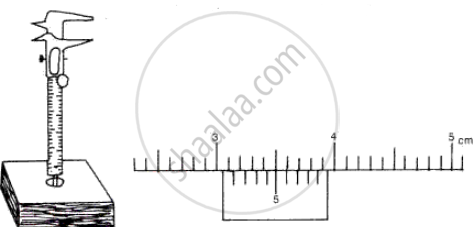
Consider the following case where the zero of vernier scale and the zero of the main scale are clearly seen. If L.C. of the vernier calipers is 0.01 cm, write the zero error and zero correction of the following.
Advertisements
Solution
Here, zero of the vernier scale lies on the right of the main scale.
Also, the 5th vernier division is coinciding with some main scale division
Thus, zero error = 0 + 5 x L.C. = -0.05 cm
Hence zero correction = 0.05 cm
APPEARS IN
RELATED QUESTIONS
(a) A vernier scale has 10 divisions. It slides over the main scale, whose pitch is 1.0 mm. If the number of divisions on the left hand of zero of the vernier scale on the main scale is 56 and the 8th vernier scale division coincides with the main scale, calculate the length in centimetres.
(b) If the above instrument has a negative error of 0.07 cm, calculate the corrected length.
The least count of a vernier callipers is 0.01 cm and it has an error of + 0.07 cm. While measuring the radius of a sphere, the main scale reading is 2.90 cm and the 5th vernier scale division coincides with the main scale. Calculate the correct radius.
Who invented vernier callipers?
A micrometre screw gauge having a positive zero error of 5 divisions is used to measure diameter of a wire, when reading on the main scale is 3rd division and the 48th circular scale division coincides with baseline. If the micrometer has 10 divisions to a centimetre on the main scale and 100 divisions on a circular scale, calculate
- Pitch of screw
- Least count of screw
- Observed diameter
- Corrected diameter.
A micrometre screw gauge has a positive zero error of 7 divisions, such that its main scale is marked in 1/2 mm and the circular scale has 100 divisions. The spindle of the screw advances by 1 division complete rotation.
If this screw gauge reading is 9 divisions on the main scale and 67 divisions on the circular scale for the diameter of a thin wire, calculate
- Pitch
- L.C.
- Observed diameter
- Corrected diameter
Name the measuring employed to measure the diameter of a needle.
What is the zero error of a screw gauge?
The following diagrams (Fig. 5) show the use of a vernier caliper under three different situations. Study the diagrams carefully and note down the vernier readings in each case.
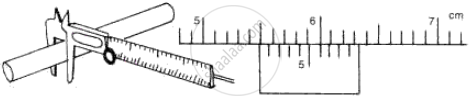
(a) Measuring the diameter of the rod
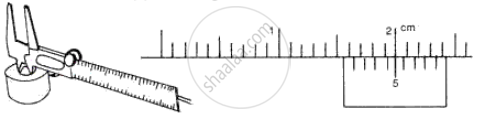
(b) Measuring Internal diameter of a cavity
(c) Measuring depth of a cavity
