Advertisements
Advertisements
Question
Advertisements
Solution
For measuring the length of an object using a vernier caliper, these steps are followed:-
(a). First of all, we find the least count and zero error of the vernier calipers.
(b). Place the object whose length is to be measured below the lower jaws and move the jaw till it touches the object. Record the main reading.
(c). Note the division on the vernier scale that coincides with some division of the main scale. Multiply this number of vernier division with least count. This is vernier scale reading.
(d). Record the observed length by adding the main scale reading and the vernier scale reading. Also, subtract zero error with its proper sign, if any, from the observed length to find the true length of the object.
APPEARS IN
RELATED QUESTIONS
A screw gauge has a least count 0.001 cm and zero error +0.007 cm. Draw a neat diagram to represent it.
Is it possible to increase the degree of accuracy by mathematical manipulations? Support your answer by an example.
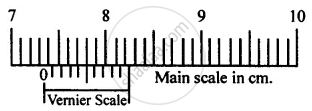
In figure for vernier callipers, calculate the length recorded.
For what range of measurement is micrometre screw gauge used?
State the formula for calculating the pitch of screw.
Explain the term least count of a screw gauge. How are they determined?
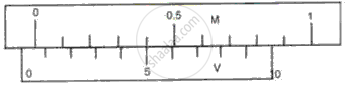
Consider the following case where the zero of vernier scale and the zero of the main scale are clearly seen. If L.C. of the vernier calipers is 0.01 cm, write the zero error and zero correction of the following.
Thickness of a cricket ball is measured by ______.
State whether true or false. If false, correct the statement.
With the help of vernier caliper we can have an accuracy of 0.1 mm and with screw gauge we can have an accuracy of 0.01 mm.
