Advertisements
Advertisements
प्रश्न
Advertisements
उत्तर
For measuring the length of an object using a vernier caliper, these steps are followed:-
(a). First of all, we find the least count and zero error of the vernier calipers.
(b). Place the object whose length is to be measured below the lower jaws and move the jaw till it touches the object. Record the main reading.
(c). Note the division on the vernier scale that coincides with some division of the main scale. Multiply this number of vernier division with least count. This is vernier scale reading.
(d). Record the observed length by adding the main scale reading and the vernier scale reading. Also, subtract zero error with its proper sign, if any, from the observed length to find the true length of the object.
APPEARS IN
संबंधित प्रश्न
The size of bacteria is 1 µ. Find the number of bacteria present in 1 m length.
Name the two scales of a vernier callipers and explain how it is used to measure length correct up to 0.01 cm.
What is the need for measuring length with vernier callipers?
The circular scale of a screw gauge has 100 divisions. Its spindle moves forward by 2.5 mm when given five complete turns. Calculate
- pitch
- least count of the screw gauge
A micrometre screw gauge having a positive zero error of 5 divisions is used to measure diameter of a wire, when reading on the main scale is 3rd division and the 48th circular scale division coincides with baseline. If the micrometer has 10 divisions to a centimetre on the main scale and 100 divisions on a circular scale, calculate
- Pitch of screw
- Least count of screw
- Observed diameter
- Corrected diameter.
State the formula for calculating the pitch of screw.
What is the least count in the case of the following instrument?
Screw gauge
What is meant by the pitch of a screw gauge? The pitch of a screw is 1 mm.
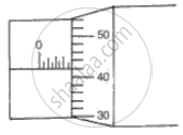
Find the reading of the instrument shown in the following figure.
State whether true or false. If false, correct the statement.
With the help of vernier caliper we can have an accuracy of 0.1 mm and with screw gauge we can have an accuracy of 0.01 mm.
How will you measure the least count of vernier caliper?
