Advertisements
Advertisements
प्रश्न
Advertisements
उत्तर

(a) Positive zero error
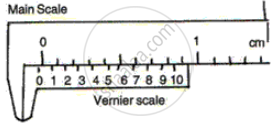
When two jaws are in contact, the zero of the vernier must coincide with the zero of the main scale. If this is not so, the instrument has zero error. These are of two types:-
a. If the zero of the vernier scale lies to the right of the zero of the main scale then it is called a positive zero error.
b. If the zero of the vernier scale lies to the left of the zero of the main scale then it is called negative zero error
To determine the zero error, note the vernier division coinciding with any main scale division when two jaws are completely closed. Suppose nth division is coinciding with the main scale. Multiply this with the least count of vernier caliper.
Positive zero error = n × L.C.
Negative zero error = - (10 - n) × L.C.
To get the correct reading, the zero error is usually subtracted from the observed reading with its proper sign
Correct reading = observed reading - zero error
APPEARS IN
संबंधित प्रश्न
Figure shows the position of vernier scale while measuring the external length of a wooden cylinder.
- What is the length recorded by the main scale?
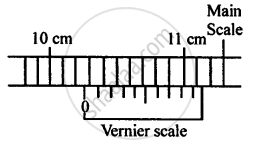
- Which reading of vernier scale coincides with the main scale?
- Calculate the length.
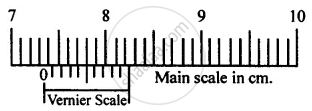
In figure for vernier callipers, calculate the length recorded.
The least count of a vernier callipers is 0.0025 cm and it has an error of + 0.0125 cm. While measuring the length of a cylinder, the reading on the main scale is 7.55 cm, and the 12th vernier scale division coincides with the main scale. Calculate the corrected length.
Who invented vernier callipers?
Up to how many decimal places can a common vernier callipers measure the length in cm?
Name the measuring employed to measure the diameter of a needle.
What is the least count in the case of the following instrument?
Screw gauge
What is the least count in the case of the following instrument?
Stopwatch
On a vernier calliper, 25 vernier scale divisions are equal in length to 24 main scale divisions. One main scale division is 1 mm. Find the least count of the instrument.
