Advertisements
Advertisements
प्रश्न
Advertisements
उत्तर

(a) Positive zero error
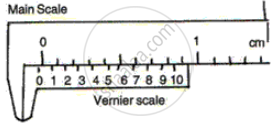
When two jaws are in contact, the zero of the vernier must coincide with the zero of the main scale. If this is not so, the instrument has zero error. These are of two types:-
a. If the zero of the vernier scale lies to the right of the zero of the main scale then it is called a positive zero error.
b. If the zero of the vernier scale lies to the left of the zero of the main scale then it is called negative zero error
To determine the zero error, note the vernier division coinciding with any main scale division when two jaws are completely closed. Suppose nth division is coinciding with the main scale. Multiply this with the least count of vernier caliper.
Positive zero error = n × L.C.
Negative zero error = - (10 - n) × L.C.
To get the correct reading, the zero error is usually subtracted from the observed reading with its proper sign
Correct reading = observed reading - zero error
APPEARS IN
संबंधित प्रश्न
The wavelength of light is 589 nm. what is its wavelength in Å?
Name the two scales of a vernier callipers and explain how it is used to measure length correct up to 0.01 cm.
A boy uses a vernier callipers to measure the thickness of his pencil. He measures it to be 1.4 mm. If the zero error of vernier callipers is +0.02 cm, what is the correct thickness of the pencil?
Why is the metre length in terms of the wavelength of light considered more accurate?
The least count of a vernier callipers is 0.01 cm and it has an error of + 0.07 cm. While measuring the radius of a sphere, the main scale reading is 2.90 cm and the 5th vernier scale division coincides with the main scale. Calculate the correct radius.
What is the function of ratchet in the screw gauge?
What is the least count in the case of the following instrument?
Spring balance
The precision of vernier calipers is ______ mm.
