Advertisements
Advertisements
प्रश्न
Advertisements
उत्तर
In order to measure the length of an object using a metre rule, the metre rule must be placed with its marking close to the object, such that the zero marking on the scale coincides with one end of the object. Then the reading on the scale corresponding to the other end of the object will give the length of the object.
Precautions to be taken for measuring the length of the object, the eye must be kept vertically above the end of the object to avoid parallax and the corresponding marking along the line should be carefully read.
The meter scale can measure up to an accuracy of 1mm or 0.1 cm
APPEARS IN
संबंधित प्रश्न
Name the part of the vernier callipers which is used to measure the following
Depth of a small bottle
In a vernier callipers, 19 main scale divisions coincide with 20 vernier scale divisions. If the main scale has 20 divisions in a centimetre, calculate
- pitch
- L.C. of vernier callipers.
Define the term least count as applied to a vernier callipers.
What is the function of ratchet in the screw gauge?
What is the least count in the case of the following instrument?
Stopwatch
What is the least count in the case of the following instrument?
Thermometer
Consider the following case where the zero of vernier scale and the zero of the main scale are clearly seen. If L.C. of the vernier calipers is 0.01 cm, write the zero error and zero correction of the following.
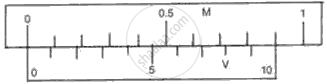
In a vernier calipers, (N + 1) divisions of vernier scale coincide with N divisions of main scale. If 1 MSD represents 0.1 mm, the vernier constant (in cm) is ______.
