Advertisements
Advertisements
प्रश्न
Advertisements
उत्तर
In order to measure the length of an object using a metre rule, the metre rule must be placed with its marking close to the object, such that the zero marking on the scale coincides with one end of the object. Then the reading on the scale corresponding to the other end of the object will give the length of the object.
Precautions to be taken for measuring the length of the object, the eye must be kept vertically above the end of the object to avoid parallax and the corresponding marking along the line should be carefully read.
The meter scale can measure up to an accuracy of 1mm or 0.1 cm
APPEARS IN
संबंधित प्रश्न
The main scale of vernier callipers has 10 divisions in a centimetre and 10 vernier scale divisions coincide with 9 main scale divisions. Calculate
- pitch
- L.C. of vernier callipers.
(a) A vernier scale has 10 divisions. It slides over the main scale, whose pitch is 1.0 mm. If the number of divisions on the left hand of zero of the vernier scale on the main scale is 56 and the 8th vernier scale division coincides with the main scale, calculate the length in centimetres.
(b) If the above instrument has a negative error of 0.07 cm, calculate the corrected length.
State the formula for determining least count for a vernier callipers.
What do you understand by the following term as applied to screw gauge?
Negative zero error
Find the volume of a book of length 25 cm, breadth 18 cm and height 2 cm in m3.
Name the measuring employed to measure the thickness of a paper.
What is the zero error of a screw gauge?
The following diagrams (Fig. 5) show the use of a vernier caliper under three different situations. Study the diagrams carefully and note down the vernier readings in each case.
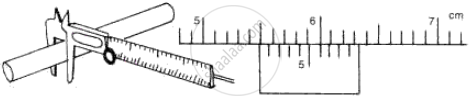
(a) Measuring the diameter of the rod
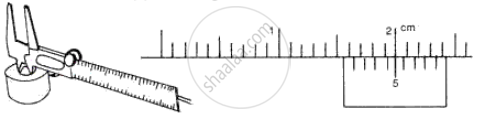
(b) Measuring Internal diameter of a cavity
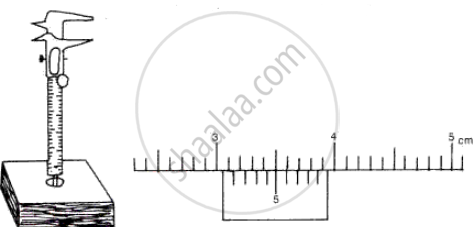
(c) Measuring depth of a cavity
The precision of vernier calipers is ______ mm.
