मराठी

Alloy is made by mixing 540 g of copper of density 9 g cm-3 with 240 g of iron of density 8 g cm-3. Find the density of the alloy assuming that the volume of each metal does not change during mixing. - Physics

Advertisements
Advertisements

प्रश्न

The following diagrams (Fig. 5) show the use of a vernier caliper under three different situations. Study the diagrams carefully and note down the vernier readings in each case.
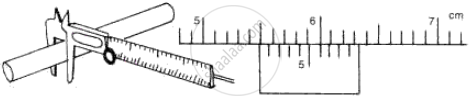
(a) Measuring the diameter of the rod
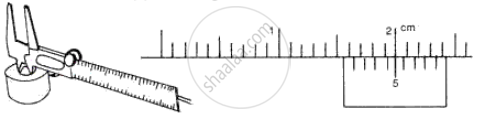
(b) Measuring Internal diameter of a cavity
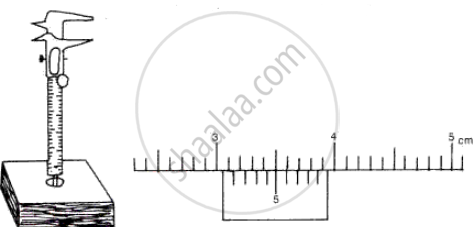
(c) Measuring depth of a cavity

थोडक्यात उत्तर
Advertisements

उत्तर

(a) Measuring the diameter of the rod

(b) Measuring Internal diameter of a cavity

(c) Measuring the depth of a cavity

Least count of vernier caliper = 0.01 cm

(i) Main scale reading = 5.5 cm
Vernier scale division coinciding with main scale = 6 Vernier scale reading = 6 × 0.01 cm = 0.06 cm
Diameter of rod = 5.5 + 0.06 = 5.56 cm

(ii) Main scale reading = 1.6 cm
Vernier scale division coinciding with main scale = 5
Vernier scale reading = 5 × 0.01 cm = 0.05 cm
Internal diameter of a cavity = 1.6 + 0.05 = 1.65 cm

(iii) Main scale reading = 3.1 cm
Vernier scale division coinciding with main scale = 5 Vernier scale reading = 5 × 0.01 cm = 0.05 cm
Depth of a cavity = 3.1 + 0.05 = 3.15 cm

shaalaa.com
Vernier Callipers
  या प्रश्नात किंवा उत्तरात काही त्रुटी आहे का?
पाठ 1: Measurement - Exercise 5 [पृष्ठ ४८]

APPEARS IN

फ्रँक Physics [English] Class 9 ICSE
पाठ 1 Measurement
Exercise 5 | Q 55 | पृष्ठ ४८

संबंधित प्रश्‍न

In the vernier callipers, there are 10 divisions on the vernier scale and 1 cm on the main scale is divided into 10 parts. While measuring the length, the zero of the vernier lies just ahead of the 1.8 cm mark and the 4th division of vernier coincides with a main scale division.

(a) Find the length.

(b) If zero error of vernier callipers is -0.02 cm,

What is the correct length ?


While measuring the length of a rod with a vernier callipers, below shows the position of its scales. What is the length of the rod? 


The pitch of a screw gauge is 0.5 mm and the head scale is divided in 100 parts. What is the least count of a screw gauge?


A screw gauge has 50 divisions on its circular scale and its screw moves by 1 mm on turning it by two revolutions. When the flat end of the screw is in contact with the stud, the zero of the circular scale lies below the base line and 4th division of the circular scale is in line with the base line. Find

(i) The pitch,

(ii) The least count and

(iii) The zero error of the screw gauge


Why is the metre length in terms of the wavelength of light considered more accurate?


(a) A vernier scale has 10 divisions. It slides over the main scale, whose pitch is 1.0 mm. If the number of divisions on the left hand of zero of the vernier scale on the main scale is 56 and the 8th vernier scale division coincides with the main scale, calculate the length in centimetres.
(b) If the above instrument has a negative error of 0.07 cm, calculate the corrected length.


A micrometre screw gauge has a negative zero error of 8 divisions. While measuring the diameter of a wire the reading on the main scale is 3 divisions and the 24th circular scale division coincides with baseline.
If the number of divisions on the main scale are 20 to a centimetre and circular scale has 50 divisions, calculate

  1. pitch
  2. observed diameter.
  3. least count
  4. corrected diameter.

How do you account for negative zero error, for calculating the correct diameter of wires?


What is the least count in the case of the following instrument?

Metre scale


The precision of vernier calipers is ______ mm.


Share
Notifications

Englishहिंदीमराठी


      Forgot password?
Use app×