Advertisements
Advertisements
प्रश्न
The following diagrams (Fig. 5) show the use of a vernier caliper under three different situations. Study the diagrams carefully and note down the vernier readings in each case.
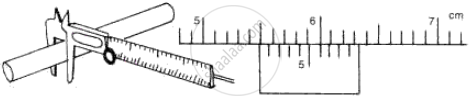
(a) Measuring the diameter of the rod
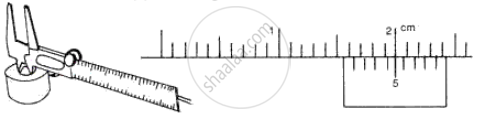
(b) Measuring Internal diameter of a cavity
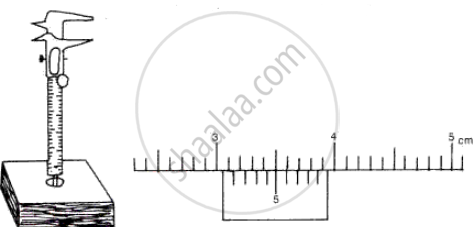
(c) Measuring depth of a cavity
Advertisements
उत्तर
(a) Measuring the diameter of the rod
(b) Measuring Internal diameter of a cavity
(c) Measuring the depth of a cavity
Least count of vernier caliper = 0.01 cm
(i) Main scale reading = 5.5 cm
Vernier scale division coinciding with main scale = 6 Vernier scale reading = 6 × 0.01 cm = 0.06 cm
Diameter of rod = 5.5 + 0.06 = 5.56 cm
(ii) Main scale reading = 1.6 cm
Vernier scale division coinciding with main scale = 5
Vernier scale reading = 5 × 0.01 cm = 0.05 cm
Internal diameter of a cavity = 1.6 + 0.05 = 1.65 cm
(iii) Main scale reading = 3.1 cm
Vernier scale division coinciding with main scale = 5 Vernier scale reading = 5 × 0.01 cm = 0.05 cm
Depth of a cavity = 3.1 + 0.05 = 3.15 cm
APPEARS IN
संबंधित प्रश्न
Name the part of the vernier callipers which is used to measure the following
Depth of a small bottle
The diameter of a thin wire can be measured by
When a screw gauge with a least count of 0.01 mm is used to measure the diameter of a wire, the reading on the sleeve is found to be 1 mm and the reading on the thimble is found to be 27 divisions.
(i) What is the diameter of the wire in cm?
(ii) If the zero error is +0.005 cm, what is the correct diameter?
Is it possible to increase the degree of accuracy by mathematical manipulations? Support your answer by an example.
The least count of a vernier callipers is 0.01 cm and it has an error of + 0.07 cm. While measuring the radius of a sphere, the main scale reading is 2.90 cm and the 5th vernier scale division coincides with the main scale. Calculate the correct radius.
Find the volume of a book of length 25 cm, breadth 18 cm and height 2 cm in m3.
State whether the following statement is true or false by writing T/F against it.
A metre scale can measure a length of 6.346 cm.
What is the least count in the case of the following instrument?
Thermometer
The following figure shows the reading of a vernier caliper used for measuring the thickness of a metal sheet.
(i) Find the least count of the instrument.
(ii) Calculate the thickness of the metal sheet.