Advertisements
Advertisements
Question
The following diagrams (Fig. 5) show the use of a vernier caliper under three different situations. Study the diagrams carefully and note down the vernier readings in each case.
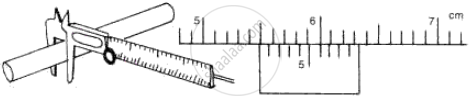
(a) Measuring the diameter of the rod
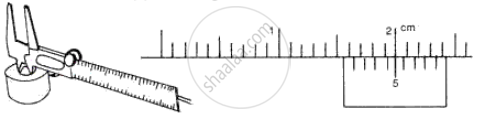
(b) Measuring Internal diameter of a cavity
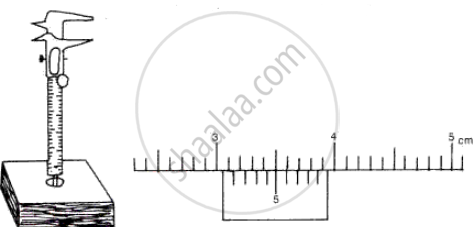
(c) Measuring depth of a cavity
Advertisements
Solution
(a) Measuring the diameter of the rod
(b) Measuring Internal diameter of a cavity
(c) Measuring the depth of a cavity
Least count of vernier caliper = 0.01 cm
(i) Main scale reading = 5.5 cm
Vernier scale division coinciding with main scale = 6 Vernier scale reading = 6 × 0.01 cm = 0.06 cm
Diameter of rod = 5.5 + 0.06 = 5.56 cm
(ii) Main scale reading = 1.6 cm
Vernier scale division coinciding with main scale = 5
Vernier scale reading = 5 × 0.01 cm = 0.05 cm
Internal diameter of a cavity = 1.6 + 0.05 = 1.65 cm
(iii) Main scale reading = 3.1 cm
Vernier scale division coinciding with main scale = 5 Vernier scale reading = 5 × 0.01 cm = 0.05 cm
Depth of a cavity = 3.1 + 0.05 = 3.15 cm
APPEARS IN
RELATED QUESTIONS
Explain the terms : Least count of a screw gauge.
How are they determined?
State the formula for determining least count for a vernier callipers.
State the formula for calculating length if:
The reading of the main scale is known and the number of vernier scale divisions coinciding with the main scale is known.
When does a vernier callipers has the positive error?
When does a vernier callipers has the negative error?
The circular scale of a screw gauge has 50 divisions. Its spindle moves by 2 mm on the sleeve, when given four complete rotations calculate
- pitch
- least count
What is the least count in the case of the following instrument?
Screw gauge
Consider the following case where the zero of vernier scale and the zero of the main scale are clearly seen. If L.C. of the vernier calipers is 0.01 cm, write the zero error and zero correction of the following.