Advertisements
Advertisements
प्रश्न
When a screw gauge with a least count of 0.01 mm is used to measure the diameter of a wire, the reading on the sleeve is found to be 1 mm and the reading on the thimble is found to be 27 divisions.
(i) What is the diameter of the wire in cm?
(ii) If the zero error is +0.005 cm, what is the correct diameter?
Advertisements
उत्तर
(i) L.C. of screw gauge = 0.01 mm or 0.001 cm
Main scale reading = 1 mm or 0.1 cm
No. of division of circular head in line with the base line (p) = 27
Circular scale reading = (p) × L.C.
= 27 × 0.001 cm
= 0.027 cm
Diameter (Total reading) = M.s.r. + circular scale reading
= (0.1 + 0.027) cm
= 0.127 cm
(ii) Zero error = 0.005 cm
Correct reading = Observed reading - zero error (with sign)
= [0.127 - (+0.005)] cm
= 0.122 cm
APPEARS IN
संबंधित प्रश्न
The least count of a vernier calipers is :
Is it possible to increase the degree of accuracy by mathematical manipulations? Support your answer by an example.
The circular scale of a screw gauge has 100 divisions. Its spindle moves forward by 2.5 mm when given five complete turns. Calculate
- pitch
- least count of the screw gauge
The thimble of a screw gauge has 50 divisions for one rotation. The spindle advances 1 mm when the screw is turned through two rotations.
- What is the pitch of the screw?
- What is the least count of screw gauge?
- When the screw gauge is used to measure the diameter of wire the reading on the sleeve is found to be 0.5 mm and reading on thimble is found, 27 divisions. What is the diameter of the wire in centimetres?
The following diagrams (Fig. 5) show the use of a vernier caliper under three different situations. Study the diagrams carefully and note down the vernier readings in each case.
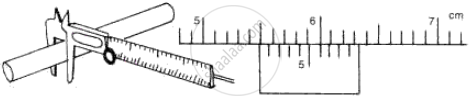
(a) Measuring the diameter of the rod
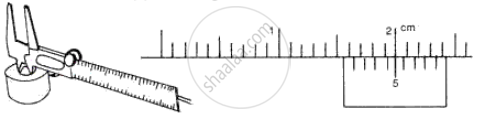
(b) Measuring Internal diameter of a cavity
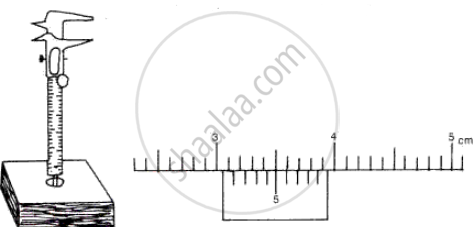
(c) Measuring depth of a cavity
Least count of a vernier caliper is ______ cm.
A vernier caliper using the scale invented by Galileo.
