Advertisements
Advertisements
Question
Advertisements
Solution
In order to measure the length of an object using a metre rule, the metre rule must be placed with its marking close to the object, such that the zero marking on the scale coincides with one end of the object. Then the reading on the scale corresponding to the other end of the object will give the length of the object.
Precautions to be taken for measuring the length of the object, the eye must be kept vertically above the end of the object to avoid parallax and the corresponding marking along the line should be carefully read.
The meter scale can measure up to an accuracy of 1mm or 0.1 cm
APPEARS IN
RELATED QUESTIONS
The wavelength of light is 589 nm. what is its wavelength in Å?
In a vernier callipers, 19 main scale divisions coincide with 20 vernier scale divisions. If the main scale has 20 divisions in a centimetre, calculate
- pitch
- L.C. of vernier callipers.
Figure shows the position of vernier scale while measuring the external length of a wooden cylinder.
- What is the length recorded by the main scale?
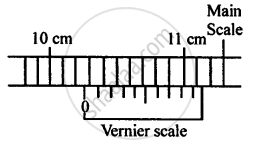
- Which reading of vernier scale coincides with the main scale?
- Calculate the length.
What is the function of ratchet in the screw gauge?
What do you understand by the following term as applied to screw gauge?
Zero error
State whether the following statement is true or false by writing T/F against it.
The diameter of a wire can be measured more accurately by using vernier calipers than by a screw gauge.
