Advertisements
Advertisements
प्रश्न
How do you account for positive zero error for calculating the correct diameter of wires?
Advertisements
उत्तर
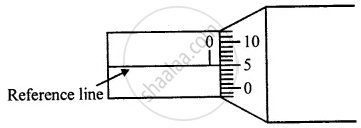
If the zero lines, marked on a circular scale, is below the reference line of the main scale, then there is a positive zero error and the correction is negative. In figure 5th, circular scale division is coinciding with the reference line.
∴ Correction = – Coinciding division of C.S. × L.C.
= – 5 × 0.001 cm
= – 0.005 cm
If the observed diameter is 0.557 cm, then:
Corrected diameter
= Observed diameter + Correction
= 0.557 cm – 0.005 cm
= 0.552 cm
APPEARS IN
संबंधित प्रश्न
Name the instrument which can accurately measure the following
The internal diameter of the neck of a water bottle
The thimble of a screw gauge has 50 divisions. The spindle advances 1 mm when the screw is turned through two revolutions.
(i) What is the pitch of the screw gauge?
(ii) What is the least count of the screw gauge?
When a screw gauge with a least count of 0.01 mm is used to measure the diameter of a wire, the reading on the sleeve is found to be 1 mm and the reading on the thimble is found to be 27 divisions.
(i) What is the diameter of the wire in cm?
(ii) If the zero error is +0.005 cm, what is the correct diameter?
How can the least count of a screw gauge be decreased?
The final result of the calculation in an experiment is 125,347,200. Express the number in term of significant place when accuracy is between 1 and 1000
Figure shows the position of vernier scale while measuring the external length of a wooden cylinder.
- What is the length recorded by the main scale?
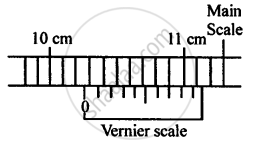
- Which reading of vernier scale coincides with the main scale?
- Calculate the length.
Define the term pitch.
What is meant by the pitch of a screw gauge? The pitch of a screw is 1 mm.
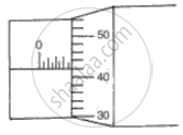
Find the reading of the instrument shown in the following figure.
In a vernier calipers, (N + 1) divisions of vernier scale coincide with N divisions of main scale. If 1 MSD represents 0.1 mm, the vernier constant (in cm) is ______.
