Advertisements
Advertisements
प्रश्न
How do you account for negative zero error, for calculating the correct diameter of wires?
Advertisements
उत्तर
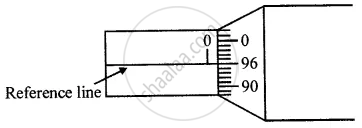
If the zero lines marked on a circular scale, is above the reference line of the main scale, then there is a negative error and the correction is positive.
In the figure, there is 96th division on the circular scale which coincides with the reference line.
∴ Correction = + [n − coinciding division of C.S. × L.C.]
where n is the total number of circular scale divisions.
∴ Correction = + [100 – 96] × 0.001 cm
= 0.004 cm
If observed diameter is 0.557 cm, then :
Corrected diameter
= Observed diameter + Correction
= 0. 557 cm + 0.004 cm
= 0.561 cm
APPEARS IN
संबंधित प्रश्न
Describe in steps, how would you use a vernier callipers to measure the length of a small rod?
A pendulum completes 2 oscillations in 5 s. What is its time period? If g = 9.8 m s-2, find its length.
State the formula for calculating length if:
Number of vernier scale division coinciding with the main scale and number of division of main scale on the left-hand side of zero of vernier scale is known.
State the formula for calculating length if:
The reading of the main scale is known and the number of vernier scale divisions coinciding with the main scale is known.
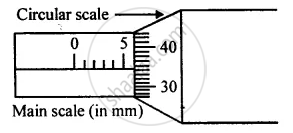
Figure shows a screw gauge in which circular scale has 200 divisions. Calculate the least count and radius of the wire.
A micrometre screw gauge has a positive zero error of 7 divisions, such that its main scale is marked in 1/2 mm and the circular scale has 100 divisions. The spindle of the screw advances by 1 division complete rotation.
If this screw gauge reading is 9 divisions on the main scale and 67 divisions on the circular scale for the diameter of a thin wire, calculate
- Pitch
- L.C.
- Observed diameter
- Corrected diameter
A micrometre screw gauge has a negative zero error of 7 divisions. While measuring the diameter of a wire the reading on the main scale is 2 divisions and 79th circular scale division coincides with baseline.
If the number of divisions on the main scale is 10 to a centimetre and circular scale has 100 divisions, calculate
- pitch
- observed diameter
- least count
- corrected diameter.
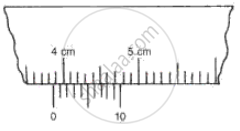
The following figure shows the reading of a vernier caliper used for measuring the thickness of a metal sheet.
(i) Find the least count of the instrument.
(ii) Calculate the thickness of the metal sheet.