Advertisements
Advertisements
प्रश्न
How do you account for negative zero error, for calculating the correct diameter of wires?
Advertisements
उत्तर
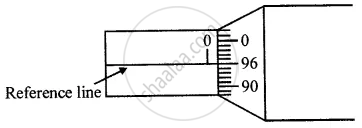
If the zero lines marked on a circular scale, is above the reference line of the main scale, then there is a negative error and the correction is positive.
In the figure, there is 96th division on the circular scale which coincides with the reference line.
∴ Correction = + [n − coinciding division of C.S. × L.C.]
where n is the total number of circular scale divisions.
∴ Correction = + [100 – 96] × 0.001 cm
= 0.004 cm
If observed diameter is 0.557 cm, then :
Corrected diameter
= Observed diameter + Correction
= 0. 557 cm + 0.004 cm
= 0.561 cm
APPEARS IN
संबंधित प्रश्न
Name the part of the vernier callipers which is used to measure the following
Thickness of a pencil.
The least count of a vernier calipers is :
The thimble of a screw gauge has 50 divisions. The spindle advances 1 mm when the screw is turned through two revolutions.
(i) What is the pitch of the screw gauge?
(ii) What is the least count of the screw gauge?
State whether the following statement is true or false by writing T/F against it.
The metre scale, vernier calipers, and screw gauge are in decreasing order of least count.
What is the least count in the case of the following instrument?
Stopwatch
What is the least count in the case of the following instrument?
Thermometer
What is the least count in the case of the following instrument?
Spring balance
In a vernier calipers, (N + 1) divisions of vernier scale coincide with N divisions of main scale. If 1 MSD represents 0.1 mm, the vernier constant (in cm) is ______.
