Advertisements
Advertisements
प्रश्न
What is meant by the pitch of a screw gauge? The pitch of a screw is 1 mm.
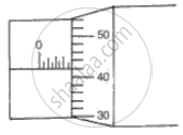
Find the reading of the instrument shown in the following figure.
Advertisements
उत्तर
When one complete rotation is given to the screw hand, it moves forward or backward by a distance is called the pitch of the screw. It is a distance between two consecutive threads of the screw.
`"Pitch of the screw" = "distance travelled by screw in n rotations"/"n rotations"`
Pitch of the screw = 1 mm
No. of divisions on circular scale = 100
`"Least count" = "pitch"/"no. of divisions"` = 0.01 mm
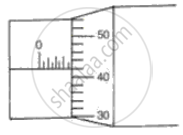
Main scale reading = 3 mm
Circular scale division coinciding with the main scale = 42
Circular scale reading = 0.01 x 42 = 0.42
Final reading = 3 + 0.42 = 3.42 mm
APPEARS IN
संबंधित प्रश्न
Name the instrument which can accurately measure the following
The internal diameter of the neck of a water bottle
The pitch of a screw gauge is 0.5 mm and the head scale is divided in 100 parts. What is the least count of a screw gauge?
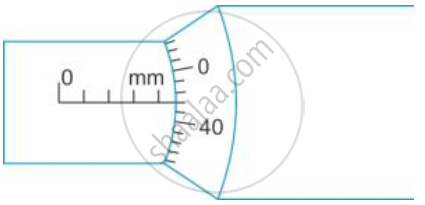
Fig., below shows the reading obtained while measuring the diameter of a wire with a screw gauge. The screw advances by 1 division on the main scale when circular head is rotated once.
 Find:
Find:
(i) Pitch of the screw gauge,
(ii) Least count of the screw gauge and
(iii) The diameter of the wire.
Why is the metre length in terms of the wavelength of light considered more accurate?
The final result of the calculation in an experiment is 125,347,200. Express the number in term of significant place when accuracy is between 1 and 10
Define the term pitch.
The thimble of a screw gauge has 50 divisions for one rotation. The spindle advances 1 mm when the screw is turned through two rotations.
- What is the pitch of the screw?
- What is the least count of screw gauge?
- When the screw gauge is used to measure the diameter of wire the reading on the sleeve is found to be 0.5 mm and reading on thimble is found, 27 divisions. What is the diameter of the wire in centimetres?
Name the measuring employed to measure the diameter of a needle.
