Advertisements
Advertisements
प्रश्न
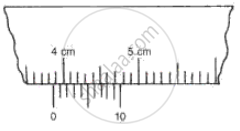
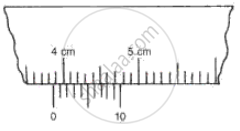
The following figure shows the reading of a vernier caliper used for measuring the thickness of a metal sheet.
(i) Find the least count of the instrument.
(ii) Calculate the thickness of the metal sheet.
Advertisements
उत्तर
(i) 1 MSD = 1 mm
10 VSD = 9 mm
1 VSD = `9/10` mm
Least count = 1 MSD - 1 VSD
=`1/10` MSD
= `1/10xx1`mm = 0.1 mm = 0.01 cm
(ii) Thickness of the metal sheet
Main scale reading = 3.9 cm
Vernier scale division coinciding with main scale = 8
Vernier scale reading = 8 x 0.01 cm = 0.08 cm
Thickness of the metal sheet = 3.9 + 0.08 = 3.98 cm
APPEARS IN
संबंधित प्रश्न
Name the two scales of a vernier callipers and explain how it is used to measure length correct up to 0.01 cm.
Define metre in terms of the wavelength of light.
The final result of the calculation in an experiment is 125,347,200. Express the number in term of significant place when accuracy is between 1 and 10
State whether the following statement is true or false by writing T/F against it.
The metre scale, vernier calipers, and screw gauge are in decreasing order of least count.
What is the least count in the case of the following instrument?
Metre scale
What is the least count in the case of the following instrument?
Screw gauge
What is the zero error of a screw gauge?
