Advertisements
Advertisements
प्रश्न
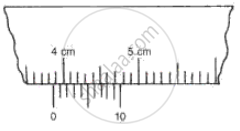
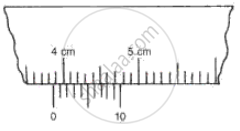
The following figure shows the reading of a vernier caliper used for measuring the thickness of a metal sheet.
(i) Find the least count of the instrument.
(ii) Calculate the thickness of the metal sheet.
Advertisements
उत्तर
(i) 1 MSD = 1 mm
10 VSD = 9 mm
1 VSD = `9/10` mm
Least count = 1 MSD - 1 VSD
=`1/10` MSD
= `1/10xx1`mm = 0.1 mm = 0.01 cm
(ii) Thickness of the metal sheet
Main scale reading = 3.9 cm
Vernier scale division coinciding with main scale = 8
Vernier scale reading = 8 x 0.01 cm = 0.08 cm
Thickness of the metal sheet = 3.9 + 0.08 = 3.98 cm
APPEARS IN
संबंधित प्रश्न
A screw gauge has a least count 0.001 cm and zero error +0.007 cm. Draw a neat diagram to represent it.
A boy uses a vernier callipers to measure the thickness of his pencil. He measures it to be 1.4 mm. If the zero error of vernier callipers is +0.02 cm, what is the correct thickness of the pencil?
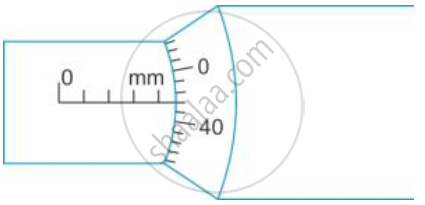
Fig., below shows the reading obtained while measuring the diameter of a wire with a screw gauge. The screw advances by 1 division on the main scale when circular head is rotated once.
 Find:
Find:
(i) Pitch of the screw gauge,
(ii) Least count of the screw gauge and
(iii) The diameter of the wire.
Why is the metre length in terms of the wavelength of light considered more accurate?
What do you understand by the following term as applied to micrometre screw gauge?
Thimble
How do you account for negative zero error, for calculating the correct diameter of wires?
State whether the following statement is true or false by writing T/F against it.
The diameter of a wire can be measured more accurately by using vernier calipers than by a screw gauge.
State whether the following statement is true or false by writing T/F against it.
The metre scale, vernier calipers, and screw gauge are in decreasing order of least count.
What is the least count in the case of the following instrument?
vernier calipers
