Advertisements
Advertisements
Question
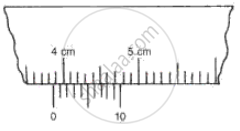
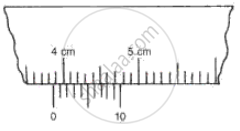
The following figure shows the reading of a vernier caliper used for measuring the thickness of a metal sheet.
(i) Find the least count of the instrument.
(ii) Calculate the thickness of the metal sheet.
Advertisements
Solution
(i) 1 MSD = 1 mm
10 VSD = 9 mm
1 VSD = `9/10` mm
Least count = 1 MSD - 1 VSD
=`1/10` MSD
= `1/10xx1`mm = 0.1 mm = 0.01 cm
(ii) Thickness of the metal sheet
Main scale reading = 3.9 cm
Vernier scale division coinciding with main scale = 8
Vernier scale reading = 8 x 0.01 cm = 0.08 cm
Thickness of the metal sheet = 3.9 + 0.08 = 3.98 cm
APPEARS IN
RELATED QUESTIONS
The pitch of a screw gauge is 0.5 mm and the head scale is divided in 100 parts. What is the least count of a screw gauge?
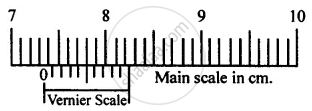
In figure for vernier callipers, calculate the length recorded.
When does a vernier callipers has the positive error?
A micrometre screw gauge has a negative zero error of 8 divisions. While measuring the diameter of a wire the reading on the main scale is 3 divisions and the 24th circular scale division coincides with baseline.
If the number of divisions on the main scale are 20 to a centimetre and circular scale has 50 divisions, calculate
- pitch
- observed diameter.
- least count
- corrected diameter.
What do you understand by the following term as applied to micrometre screw gauge?
Thimble
State the formula for calculating the pitch of screw.
The precision of vernier calipers is ______ mm.
