Advertisements
Advertisements
Question
Advertisements
Solution
Due to constant use, there is space for the play of screw gauge but gradually this space increases with the use or wear and tear so that when the screw is moved by rotating it in some direction, it slips in the nut and does not cover any linear distance for some rotation of the screw head. The error due to this is known as backlash error.
It is avoided by turning the screw always in the same direction.
APPEARS IN
RELATED QUESTIONS
Name the part of the vernier callipers which is used to measure the following
External diameter of a tube
The pitch of a screw gauge is 0.5 mm and the head scale is divided in 100 parts. What is the least count of a screw gauge?
The thimble of a screw gauge has 50 divisions. The spindle advances 1 mm when the screw is turned through two revolutions.
(i) What is the pitch of the screw gauge?
(ii) What is the least count of the screw gauge?
Who invented vernier callipers?
Name the measuring employed to measure the diameter of a needle.
What is meant by the pitch of a screw gauge? The pitch of a screw is 1 mm.
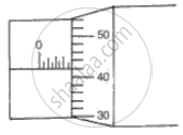
Find the reading of the instrument shown in the following figure.