Advertisements
Advertisements
Question
Advertisements
Solution
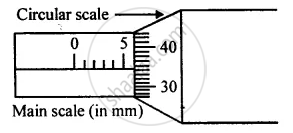
The following procedure is used to measure the diameter of a wire
(a). Calculate the least count and zero error of the screw gauge.
(b). Place the wire in between the studs. Turn the ratchet clockwise so as to hold the wire gently in between the studs. Record the main scale reading.
(c). Now record the division of circular scale that coincides with the base line of the main scale. This circular scale division multiplied by the least count will give circular scale reading.
(d). The observed diameter is obtained by adding the circular scale reading to the main scale reading. Subtract the zero error if any, with its proper sign, from the observed diameter to get the true diameter.
APPEARS IN
RELATED QUESTIONS
State the purpose of ratchet in a screw gauge.
Describe the procedure to measure the diameter of a wire with the help of a screw gauge.
(a) A vernier scale has 20 divisions. It slides over the main scale, whose pitch is 0.5 mm. If the number of divisions on the left hand of the zero of vernier on the main scale is 38 and the 18th vernier scale division coincides with the main scale, calculate the diameter of the sphere, held in the jaws of vernier callipers.
(b) If the vernier has a negative error of 0.04 cm, calculate the corrected radius of the sphere.
State the formula for calculating length if:
Number of vernier scale division coinciding with the main scale and number of division of main scale on the left-hand side of zero of vernier scale is known.
Figure shows a screw gauge in which circular scale has 200 divisions. Calculate the least count and radius of the wire.
For what range of measurement is micrometre screw gauge used?
What do you understand by the following term as applied to micrometre screw gauge?
Sleeve scale
State whether the following statement is true or false by writing T/F against it.
The least count of a screw gauge can be lowered by increasing the number of divisions on its thimble.
A Vernier calliper reads a main scale reading of 2.3 cm and the 5th division of the Vernier scale coincides with a main scale division. If the least count is 0.01 cm, what is the actual reading?
