Advertisements
Advertisements
Question
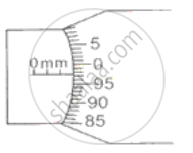
In the following figure, the pitch of the screw is 1 mm. Calculate:
(i) the least count of screw gauge and
(ii) the reading represented in the figure.
Advertisements
Solution
Screw gauge in the figure
(i) Pitch of the screw = 1 mm
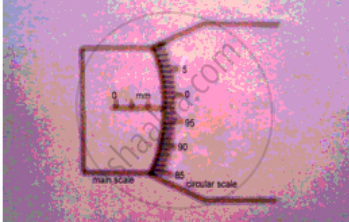
Divisions on circular scale= 100
least count = pitch of the screw/ divisions on the main scale
L.C. = 1/100 = 0.01 mm= 0.001 cm
(ii) LC. = 0.001 cm
the main scale reading = 2 mm= 0.2 cm
from the figure it is clear that base line coincides with the 97th division of the circular scale.
So, circular scale reading= 97 X 0.001 cm = 0.097 cm Hence, reading shown In the figure= 0.2 + 0.097 = 0.297 cm
APPEARS IN
RELATED QUESTIONS
The pitch of a screw gauge is 0.5 mm and the head scale is divided in 100 parts. What is the least count of a screw gauge?
What is the need for measuring length with vernier callipers?
When does a vernier callipers has the positive error?
What is the backlash error?
Name the measuring employed to measure the diameter of a needle.
