Advertisements
Advertisements
प्रश्न
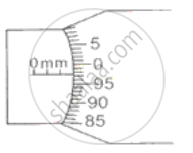
In the following figure, the pitch of the screw is 1 mm. Calculate:
(i) the least count of screw gauge and
(ii) the reading represented in the figure.
Advertisements
उत्तर
Screw gauge in the figure
(i) Pitch of the screw = 1 mm
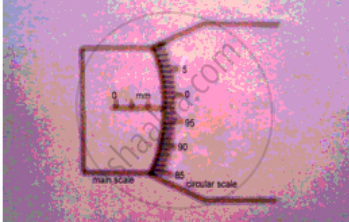
Divisions on circular scale= 100
least count = pitch of the screw/ divisions on the main scale
L.C. = 1/100 = 0.01 mm= 0.001 cm
(ii) LC. = 0.001 cm
the main scale reading = 2 mm= 0.2 cm
from the figure it is clear that base line coincides with the 97th division of the circular scale.
So, circular scale reading= 97 X 0.001 cm = 0.097 cm Hence, reading shown In the figure= 0.2 + 0.097 = 0.297 cm
APPEARS IN
संबंधित प्रश्न
Name the part of the vernier callipers which is used to measure the following
External diameter of a tube
Name the part of the vernier callipers which is used to measure the following
Depth of a small bottle
The pitch of a screw gauge is 1 mm and the circular scale has 100 divisions. In measurement of the diameter of a wire, the main scale reads 2 mm and 45th mark on the circular scale coincides with the base line. Find
(i) The least count and
(ii) The diameter of the wire.
State the formula for determining a pitch
What do you understand by the following term as applied to micrometre screw gauge?
Thimble scale
What do you understand by the following term as applied to micrometre screw gauge?
Baseline
How will you measure the least count of vernier caliper?
