Advertisements
Advertisements
प्रश्न
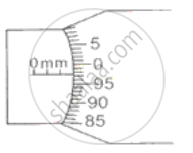
In the following figure, the pitch of the screw is 1 mm. Calculate:
(i) the least count of screw gauge and
(ii) the reading represented in the figure.
Advertisements
उत्तर
Screw gauge in the figure
(i) Pitch of the screw = 1 mm
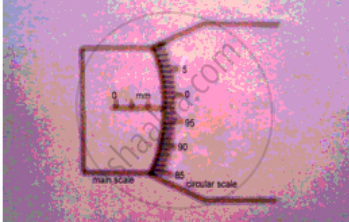
Divisions on circular scale= 100
least count = pitch of the screw/ divisions on the main scale
L.C. = 1/100 = 0.01 mm= 0.001 cm
(ii) LC. = 0.001 cm
the main scale reading = 2 mm= 0.2 cm
from the figure it is clear that base line coincides with the 97th division of the circular scale.
So, circular scale reading= 97 X 0.001 cm = 0.097 cm Hence, reading shown In the figure= 0.2 + 0.097 = 0.297 cm
APPEARS IN
संबंधित प्रश्न
A vernier callipers has a zero error of + 0.06 cm. Draw a neat labelled diagram to represent it.
Describe in steps, how would you use a vernier callipers to measure the length of a small rod?
What do you mean by zero error of a screw gauge? How is it accounted for?
Why is the metre length in terms of the wavelength of light considered more accurate?
The circular scale of a screw gauge has 50 divisions. Its spindle moves by 2 mm on the sleeve, when given four complete rotations calculate
- pitch
- least count
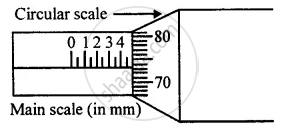
Figure shows a screw gauge in which circular scale has 100 divisions. Calculate the least count and the diameter of a wire.
What do you understand by the following term as applied to micrometre screw gauge?
Baseline
State whether the following statement is true or false by writing T/F against it.
The metre scale, vernier calipers, and screw gauge are in decreasing order of least count.
Thickness of a cricket ball is measured by ______.
State whether true or false. If false, correct the statement.
With the help of vernier caliper we can have an accuracy of 0.1 mm and with screw gauge we can have an accuracy of 0.01 mm.
