Advertisements
Advertisements
Question
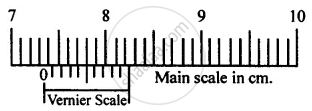
In figure for vernier callipers, calculate the length recorded.
Advertisements
Solution
Main scale divisions of vernier callipers in one centimetre = 10
Pitch = `"Unit of main scale"/"Number of divisions in the unit"`
= `1/10` cm = 0.1 cm
Least count (L.C.) = `"Pitch"/"No. of divisions on the vernier scale"`
L.C. = `0.1/10` cm = 0.01 cm
Here main scale reading = 7.3 cm
Vernier scale reading (V.S.D.) coinciding with main scale = 5th
Length recorded = Main scale reading + L.C. × V.S.D.
= 7.3 + 0.01 × 5
= 7.3 + 0.05
= 7.35 cm
APPEARS IN
RELATED QUESTIONS
The size of bacteria is 1 µ. Find the number of bacteria present in 1 m length.
A vernier callipers has a zero error of + 0.06 cm. Draw a neat labelled diagram to represent it.
Name the part of the vernier callipers which is used to measure the following
Internal diameter of a mug
Is it possible to increase the degree of accuracy by mathematical manipulations? Support your answer by an example.
Up to how many decimal places can a common vernier callipers measure the length in cm?
Name the measuring employed to measure the diameter of a needle.
What is the least count in the case of the following instrument?
Spring balance
The following figure shows the reading of a vernier caliper used for measuring the thickness of a metal sheet.
(i) Find the least count of the instrument.
(ii) Calculate the thickness of the metal sheet.