Advertisements
Advertisements
Question
A screw gauge has 50 divisions on its circular scale and its screw moves by 1 mm on turning it by two revolutions. When the flat end of the screw is in contact with the stud, the zero of the circular scale lies below the base line and 4th division of the circular scale is in line with the base line. Find
(i) The pitch,
(ii) The least count and
(iii) The zero error of the screw gauge
Advertisements
Solution
No. of divisions on the circular scale = 50
(i) Pitch = Distance moved ahead in one revolution
= 1 mm/2 = 0.5 mm
(ii) L.C. = Pitch/No. of divisions on the circular head
= (0.5/50) mm
= 0.01 mm
(iii) Because the zero of the circular scale lies below the base line, when the flat end of the screw is in contact with the stud, the error is positive.
No. of circular division coinciding with m.s.d. = 4
Zero error = + (4 × L.C.)
= + (4 × 0.01) mm
= + 0.04 mm
APPEARS IN
RELATED QUESTIONS
A vernier callipers has a zero error of + 0.06 cm. Draw a neat labelled diagram to represent it.
Name the part of the vernier callipers which is used to measure the following
External diameter of a tube
The circular scale of a screw gauge has 100 divisions. Its spindle moves forward by 2.5 mm when given five complete turns. Calculate
- pitch
- least count of the screw gauge
Figure shows a screw gauge in which circular scale has 100 divisions. Calculate the least count and the diameter of a wire.
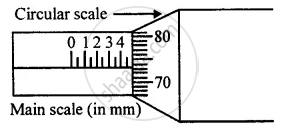
State the formula for calculating the pitch of screw.
Name the measuring employed to measure the diameter of a pencil.
Least count of a vernier caliper is ______ cm.
In a vernier calliper, (N + 1) divisions of the vernier scale coincide with N divisions of the main scale. If 1 MSD represents 0.1 mm, the vernier constant (in cm) is ______.
