Advertisements
Advertisements
Question
How is the time period of a simple pendulum affected, if at all, in the following situations:
- The length is made four times.
- The acceleration due to gravity is reduced to one-fourth.
Advertisements
Solution
We know that, `"T" = 2pisqrt(l/"g")`
(a) If length quadruples then,
`T' = 2pisqrt((4l)/"g")`
or, `T/(T')`
= `(2pisqrt(l/"g"))/(2pisqrt((4l)/"g"))`
= `1/2`
or, T = 2T'
Therefore, the time period is doubled.
(b) If the acceleration due to gravity is reduced to one-fourth,
`T' = 2pisqrt(l/(1/4"g"))`
or, `"T"/("T"')`
= `(2pisqrt(l/"g"))/(2pisqrt(l/(1/4"g"))`
= `1/2`
or, T = 2T'
Therefore, the time period is doubled.
APPEARS IN
RELATED QUESTIONS
How do you measure the time period of a given pendulum? Why do you note the time for more than one oscillation?
Two simple pendulums A and B have lengths 1.0 m and 4.0 m, respectively, at a certain place. Which pendulum will make more oscillations in 1 min? Explain your answer.
The frequency of sound is measured in ______.
Explain how the frequency of oscillation is related to the length of a pendulum and the amplitude of its oscillation.
Explain the two ways by which the pitch of the sound generated by a stretched string can be changed.
Two clocks A and B are shown in the following figure. Clock A has an hour and a minute hand, whereas clock B has an hour hand, a minute hand as well as a second hand. Which of the following statement is correct for these clocks?
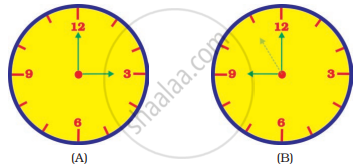
Give scientific reasons.
In earlier times, people used to listen for the arrival of a distant train by putting their ear to the rail.
Give scientific reason.
In earlier times, people used to listen for the arrival of a distant train by putting their ear to the rail.
Give scientific reason.
In earlier times, people used to listen for the arrival of a distant train by putting their ear to the rail.
You can perform an interesting activity when you visit a park to ride a swing. You will require a watch. Make the swing oscillate without anyone sitting on it. Find its time period in the same way as you did for the pendulum. Make sure that there are no jerks in the motion of the swing. Ask one of your friends to sit on the swing. Push it once and let it swing naturally. Again measure its time period. Repeat the activity with different persons sitting on the swing. Compare the time period of the swing measured in different cases. What conclusions do you draw from this activity?
