Advertisements
Advertisements
Question
How do you measure the time period of a given pendulum? Why do you note the time for more than one oscillation?
Advertisements
Solution
Measurement of time period of a simple pendulum:
(i) To measure the time period of a simple pendulum, the bob is slightly displaced from its mean position and is then released. This gives a to and fro motion about the mean position to the pendulum.
(ii) The time 't' for 20 complete oscillations is measured with the help of a stopwatch.
(iii) Time period 'T' can be found by dividing 't' by 20.
To find the time period, the time for the number of oscillations more than 1 is noted because the least count of stopwatch is either 1 s or 0.5 s. It cannot record the time period in fractions such as 1.2 or 1.4 and so on.
APPEARS IN
RELATED QUESTIONS
How is the time period of a simple pendulum affected, if at all, in the following situations:
- The length is made four times.
- The acceleration due to gravity is reduced to one-fourth.
Two simple pendulums A and B have lengths 1.0 m and 4.0 m, respectively, at a certain place. Which pendulum will make more oscillations in 1 min? Explain your answer.
State how does the time period of a simple pendulum depend on (a) length of pendulum, (b) mass of bob, (c) amplitude of oscillation and (d) acceleration due to gravity.
The frequency of sound is measured in ______.
Explain how the frequency of oscillation is related to the length of a pendulum and the amplitude of its oscillation.
Explain the two ways by which the pitch of the sound generated by a stretched string can be changed.
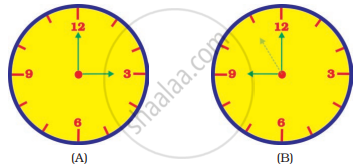
Two clocks A and B are shown in the following figure. Clock A has an hour and a minute hand, whereas clock B has an hour hand, a minute hand as well as a second hand. Which of the following statement is correct for these clocks?
Give scientific reason.
In earlier times, people used to listen for the arrival of a distant train by putting their ear to the rail.
Give scientific reason.
In earlier times, people used to listen for the arrival of a distant train by putting their ear to the rail.
Give scientific reason.
In earlier times, people used to listen for the arrival of a distant train by putting their ear to the rail.
