Advertisements
Chapters
2: Powers
3: Squares and Square Roots
4: Cubes and Cube Roots
5: Playing with Numbers
6: Algebraic Expressions and Identities
7: Factorization
8: Division of Algebraic Expressions
9: Linear Equation in One Variable
10: Direct and Inverse Variations
11: Time and Work
12: Percentage
13: Proft, Loss, Discount and Value Added Tax (VAT)
14: Compound Interest
15: Understanding Shapes-I (Polygons)
▶ 16: Understanding Shapes-II (Quadrilaterals)
17: Understanding Shapes-III (Special Types of Quadrilaterals)
18: Practical Geometry (Constructions)
19: Visualising Shapes
20: Mensuration - I (Area of a Trapezium and a Polygon)
21: Mensuration - II (Volumes and Surface Areas of a Cuboid and a Cube)
22: Mensuration - III (Surface Area and Volume of a Right Circular Cylinder)
23: Data Handling-I (Classification and Tabulation of Data)
24: Data Handling-II (Graphical Representation of Data as Histograms)
25: Data Handling-III (Pictorial Representation of Data as Pie Charts or Circle Graphs)
26: Data Handling-IV (Probability)
27: Introduction to Graphs
![RD Sharma solutions for Mathematics [English] Class 8 chapter 16 - Understanding Shapes-II (Quadrilaterals) - Shaalaa.com](/images/mathematics-english-class-8_6:d71f9951bde04f9981d965449678818b.jpg "RD Sharma solutions for Mathematics [English] Class 8 chapter 16 - Understanding Shapes-II (Quadrilaterals)")
Advertisements
Solutions for Chapter 16: Understanding Shapes-II (Quadrilaterals)
Below listed, you can find solutions for Chapter 16 of CBSE RD Sharma for Mathematics [English] Class 8.
RD Sharma solutions for Mathematics [English] Class 8 16 Understanding Shapes-II (Quadrilaterals) Exercise 16.1 [Pages 15 - 17]
Define the following term Quadrilateral .
Define the following term Convex Quadrilateral .
In a quadrilateral, define of the following Sides.
In a quadrilateral, define of the following Vertices .
In a quadrilateral, define of the following Angles .
In a quadrilateral, define of the following Diagonals .
In a quadrilateral, define of the following Adjacent angles .
In a quadrilateral, define of the following Adjacent sides .
In a quadrilateral, define of the following Opposite sides .
In a quadrilateral, define of the following Opposite angles .
In a quadrilateral, define of the following Interior .
In a quadrilateral, define of the following Exterior .
Complete of the following, so as to make a true statement:
A quadrilateral has ....... sides.
Complete of the following, so as to make a true statement:
A quadrilateral has ...... angles.
Complete of the following, so as to make a true statement:
A quadrilateral has ..... vertices, no three of which are .....
Complete of the following, so as to make a true statement:
A quadrilateral has .... diagonals.
Complete of the following, so as to make a true statement:
The number of pairs of adjacent angles of a quadrilateral is .......
Complete of the following, so as to make a true statement:
The number of pairs of opposite angles of a quadrilateral is .......
Complete of the following, so as to make a true statement:
The sum of the angles of a quadrilateral is ......
Complete of the following, so as to make a true statement:
A diagonal of a quadrilateral is a line segment that joins two ...... vertices of the quadrilateral.
Complete of the following, so as to make a true statement:
The sum of the angles of a quiadrilateral is .... right angles.
Complete of the following, so as to make a true statement:
The measure of each angle of a convex quadrilateral is ..... 180°.
Complete of the following, so as to make a true statement:
In a quadrilateral the point of intersection of the diagonals lies in .... of the quadrilateral.
Complete of the following, so as to make a true statement:
A point is in the interior of a convex quadrilateral, if it is in the ..... of its two opposite angles.
Complete of the following, so as to make a true statement:
A quadrilateral is convex if, for each side, the remaining ______ lie on the same side of the line containing the side.
In Fig. 16.19, ABCD is a quadrilateral.
Name a pair of adjacent sides.
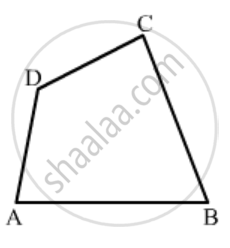
In Fig. 16.19, ABCD is a quadrilateral.
Name a pair of opposite sides.
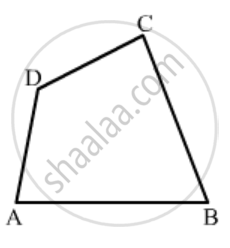
In Fig. 16.19, ABCD is a quadrilateral.
How many pairs of adjacent sides are there?
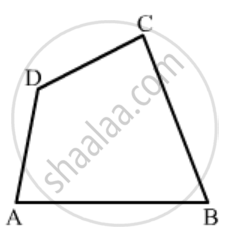
In Fig. 16.19, ABCD is a quadrilateral.
How many pairs of opposite sides are there?
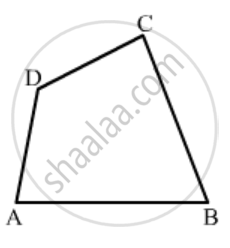
In Fig. 16.19, ABCD is a quadrilateral.
Name a pair of adjacent angles.
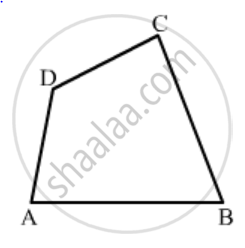
In Fig. 16.19, ABCD is a quadrilateral.
Name a pair of opposite angles.
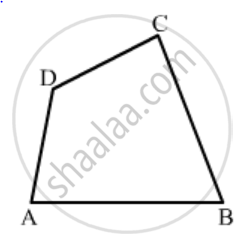
In Fig. 16.19, ABCD is a quadrilateral.
How many pairs of adjacent angles are there?
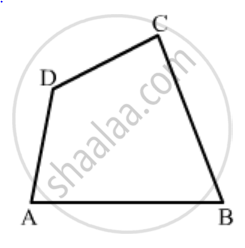
In Fig. 16.19, ABCD is a quadrilateral.
How many pairs of opposite angles are there?
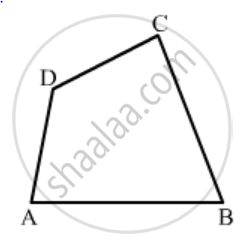
The angles of a quadrilateral are 110°, 72°, 55° and x°. Find the value of x.
The three angles of a quadrilateral are respectively equal to 110°, 50° and 40°. Find its fourth angle.
A quadrilateral has three acute angles each measures 80°. What is the measure of the fourth angle?
A quadrilateral has all its four angles of the same measure. What is the measure of each?
Two angles of a quadrilateral are of measure 65° and the other two angles are equal. What is the measure of each of these two angles?
Three angles of a quadrilateral are equal. Fourth angle is of measure 150°. What is the measure of equal angles.
The four angles of a quadrilateral are as 3 : 5 : 7 : 9. Find the angles.
If the sum of the two angles of a quadrilateral is 180°. What is the sum of the remaining two angles?
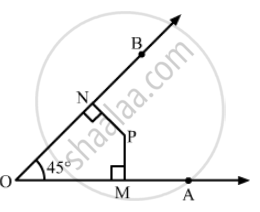
In Fig. 16.20, find the measure of ∠MPN.
The sides of a quadrilateral are produced in order. What is the sum of the four exterior angles?
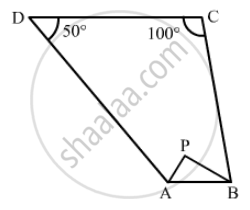
In Fig. 16.21, the bisectors of ∠A and ∠B meet at a point P. If ∠C = 100° and ∠D = 50°, find the measure of ∠APB.
In a quadrilateral ABCD, the angles A, B, C and D are in the ratio 1 : 2 : 4 : 5. Find the measure of each angle of the quadrilateral.
In a quadrilateral ABCD, CO and DO are the bisectors of ∠C and ∠D respectively. Prove that \[∠COD = \frac{1}{2}(∠A + ∠B) .\]
Find the number of side of a regular polygon, when of its angle has a measure of 160° .
Find the number of side of a regular polygon, when of its angle has a measure of 135° .
Find the number of side of a regular polygon, when of its angle has a measure of 175° .
Find the number of side of a regular polygon, when of its angle has a measure of 162° .
Find the number of side of a regular polygon, when of its angle has a measure of 150° .
Find the number of degrees in each exterior exterior angle of a regular pentagon.
The measure of angles of a hexagon are x°, (x − 5)°, (x − 5)°, (2x − 5)°, (2x − 5)°, (2x + 20)°. Find the value of x.
In a convex hexagon, prove that the sum of all interior angle is equal to twice the sum of its exterior angles formed by producing the sides in the same order.
The sum of the interior angles of a polygon is three times the sum of its exterior angles. Determine the number of sided of the polygon.
Determine the number of sides of a polygon whose exterior and interior angles are in the ratio 1 : 5.
PQRSTU is a regular hexagon. Determine each angle of ΔPQT.
Solutions for 16: Understanding Shapes-II (Quadrilaterals)
RD Sharma solutions for Mathematics [English] Class 8 chapter 16 - Understanding Shapes-II (Quadrilaterals)
Shaalaa.com has the CBSE Mathematics Mathematics [English] Class 8 CBSE solutions in a manner that help students grasp basic concepts better and faster. The detailed, step-by-step solutions will help you understand the concepts better and clarify any confusion. RD Sharma solutions for Mathematics Mathematics [English] Class 8 CBSE 16 (Understanding Shapes-II (Quadrilaterals)) include all questions with answers and detailed explanations. This will clear students' doubts about questions and improve their application skills while preparing for board exams.
Further, we at Shaalaa.com provide such solutions so students can prepare for written exams. RD Sharma textbook solutions can be a core help for self-study and provide excellent self-help guidance for students.
Concepts covered in Mathematics [English] Class 8 chapter 16 Understanding Shapes-II (Quadrilaterals) are Properties of Trapezium, Properties of Kite, Classification of Polygons, Properties of a Parallelogram, Concept of Curves, Basic Concept of Polygons, Quadrilaterals, Property: The diagonals of a rhombus are perpendicular bisectors of one another., Properties of Rhombus, Property: The Opposite Sides of a Parallelogram Are of Equal Length., Property: The Opposite Angles of a Parallelogram Are of Equal Measure., Property: The adjacent angles in a parallelogram are supplementary., Property: The diagonals of a parallelogram bisect each other. (at the point of their intersection), Sum of Interior Angles of a Polygon, Property: The Diagonals of a Rectangle Are of Equal Length., Properties of Rectangle, Properties of a Square, Property: The diagonals of a square are perpendicular bisectors of each other., Properties of Quadrilateral, Different Types of Curves - Closed Curve, Open Curve, Simple Curve., Sum of Exterior Angles of a Polygon.
Using RD Sharma Mathematics [English] Class 8 solutions Understanding Shapes-II (Quadrilaterals) exercise by students is an easy way to prepare for the exams, as they involve solutions arranged chapter-wise and also page-wise. The questions involved in RD Sharma Solutions are essential questions that can be asked in the final exam. Maximum CBSE Mathematics [English] Class 8 students prefer RD Sharma Textbook Solutions to score more in exams.
Get the free view of Chapter 16, Understanding Shapes-II (Quadrilaterals) Mathematics [English] Class 8 additional questions for Mathematics Mathematics [English] Class 8 CBSE, and you can use Shaalaa.com to keep it handy for your exam preparation.
