Advertisements
Advertisements
Question
In a convex hexagon, prove that the sum of all interior angle is equal to twice the sum of its exterior angles formed by producing the sides in the same order.
Advertisements
Solution
\[\text{ For a convex hexagon, interior angle } = \left( \frac{2n - 4}{n} \times 90° \right)\]
\[\text{ For a hexagon,} n = 6\]
\[ \therefore \text{ Interior angle } = \left( \frac{12 - 4}{6} \times 90° \right)\]
\[ = \left( \frac{8}{6} \times 90° \right)\]
\[ = 120°\]
\[\text{ So, the sum of all the interior angles } = 120° + 120° + 120° + 120° + 120° + 120° = 720° \]
\[ \therefore \text{ Exterior angle } = \left( \frac{360}{n} \right)^° = \left( \frac{360}{6} \right)^° = {60}^° \]
\[\text{ So, sum of all the exterior angles } = {60}^° + {60}^° + {60}^° + {60}^° + {60}^° + {60}^° = {360}^° \]
\[\text{ Now, sum of all interior angles } = 720° \]
\[ = 2\left( 360° \right)\]
\[ = \text{ twice the exterior angles } \]
\[\text{ Hence proved } .\]
RELATED QUESTIONS
Complete of the following, so as to make a true statement:
A quadrilateral has ...... angles.
Complete of the following, so as to make a true statement:
In a quadrilateral the point of intersection of the diagonals lies in .... of the quadrilateral.
If ABCD is a rectangle with ∠BAC = 32°, find the measure of ∠DBC.
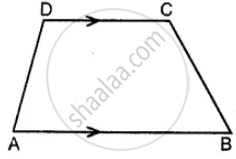
The following figure shows a quadrilateral in which sides AB and DC are parallel. If ∠A : ∠D = 4 : 5, ∠B = (3x – 15)° and ∠C = (4x + 20)°, find each angle of the quadrilateral ABCD.
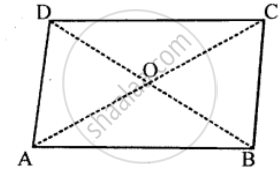
In a parallelogram ABCD, its diagonals AC and BD intersect each other at point O.

If AC = 12 cm and BD = 9 cm ; find; lengths of OA and OD.
In parallelogram ABCD, its diagonals intersect at point O. If OA = 6 cm and OB = 7.5 cm, find the length of AC and BD.
In the figure, PQRS and PTVS are two cyclic quadrilaterals, If ∠QRS = 100°, then ∠TVS =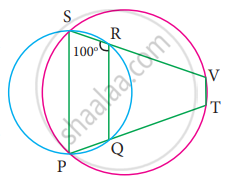
D and E are the mid-points of the sides AB and AC respectively of ∆ABC. DE is produced to F. To prove that CF is equal and parallel to DA, we need an additional information which is ______.
In the following figure, if point A is shifted to point B along the ray PX such that PB = 2PA, then the measure of ∠BPY is ______.

Using the information given, name the right angles in part of figure:
AE ⊥ CE

