Advertisements
Advertisements
Question
Two angles of a quadrilateral are 89° and 113°. If the other two angles are equal; find the equal angles.
Advertisements
Solution
Let the other angle = x°
According to given,
89° + 113° + x° + x° = 360°
2x° = 360° – 202°
2x° = 158°
x° = `158/2`
other two angles = 79° each
RELATED QUESTIONS
Complete of the following, so as to make a true statement:
A quadrilateral has ...... angles.
Complete of the following, so as to make a true statement:
The number of pairs of adjacent angles of a quadrilateral is .......
In a quadrilateral ABCD, CO and DO are the bisectors of ∠C and ∠D respectively. Prove that \[∠COD = \frac{1}{2}(∠A + ∠B) .\]
Complete the following statement by means of one of those given in brackets against each:
A line drawn from the mid-point of one side of a triangle .............. another side intersects the third side at its mid-point.
Given : In quadrilateral ABCD ; ∠C = 64°, ∠D = ∠C – 8° ; ∠A = 5(a+2)° and ∠B = 2(2a+7)°.
Calculate ∠A.
Three angles of a quadrilateral are equal. If the fourth angle is 69°; find the measure of equal angles.
In a quadrilateral ABCD, AO and BO are bisectors of angle A and angle B respectively. Show that:
∠AOB = (∠C + ∠D)
Two opposite angles of a parallelogram are 100° each. Find each of the other two opposite angles.
Two adjacent angles of a parallelogram are 70° and 110° respectively. Find the other two angles of it.
In parallelogram ABCD, its diagonals intersect at point O. If OA = 6 cm and OB = 7.5 cm, find the length of AC and BD.
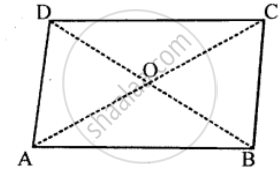
If three angles of a quadrilateral are 90° each, show that the given quadrilateral is a rectangle.
Find the angles of a pentagon which are in the ratio 4: 4: 6: 7: 6.
ΔPQR and ΔSQR are on the same base QR with P and S on opposite sides of line QR, such that area of ΔPQR is equal to the area of ΔSQR. Show that QR bisects PS.
Three angles of a quadrilateral are 75º, 90º and 75º. The fourth angle is ______.
The number of right angles in a straight angle is ______ and that in a complete angle is ______.
The number of common points in the two angles marked in the following figure is ______.

Draw a rough sketch of a quadrilateral KLMN. State two pairs of opposite angles.
How many points are required to form a quadrilateral?
In quadrilateral PQRS, which pair represents adjacent sides?
Which of the following is a key requirement for correctly naming a □ABCD?
