Advertisements
Advertisements
Question
If three angles of a quadrilateral are 90° each, show that the given quadrilateral is a rectangle.
Advertisements
Solution
The given quadrilateral ABCD will be a rectangle, if its each angle is 90°
Since, the sum of interior angles of a quadrilateral is 360°.
∴∠A +∠B + ∠C + ∠D = 360°
⇒ 90° + 90° + 90° + ∠D = 360°
⇒ 270° + ∠D = 360°
⇒ ∠D = 360° – 270°
⇒ ∠D = 90°
Since, each angle of the quadrilateral is 90°. ∴The given quadrilateral is a rectangle.
APPEARS IN
RELATED QUESTIONS
How many diagonals does following have?
A triangle
Complete of the following, so as to make a true statement:
The number of pairs of opposite angles of a quadrilateral is .......
Complete of the following, so as to make a true statement:
The sum of the angles of a quiadrilateral is .... right angles.
A quadrilateral has three acute angles each measures 80°. What is the measure of the fourth angle?
In a trapezium ABCD, side AB is parallel to side DC. If ∠A = x° and ∠D = (3x – 20)°; find the value of x.
In parallelogram ABCD, its diagonals intersect at point O. If OA = 6 cm and OB = 7.5 cm, find the length of AC and BD.
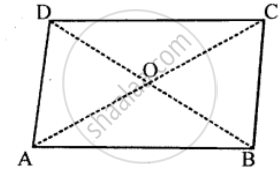
One diagonal of a rectangle is 18 cm. What is the length of its other diagonal?
Observe the figure below and find out their name.

In the following figure, What is AE + EC?

How many points are required to form a quadrilateral?
