Advertisements
Advertisements
Question
Complete of the following, so as to make a true statement:
The sum of the angles of a quiadrilateral is .... right angles.
Advertisements
Solution
The sum of the angles of a quiadrilateral is four right angles.
RELATED QUESTIONS
In a quadrilateral, define of the following Opposite angles .
Complete of the following, so as to make a true statement:
A quadrilateral has ....... sides.
Complete of the following, so as to make a true statement:
A quadrilateral has .... diagonals.
The angles A, B, C and D of a trapezium ABCD are in the ratio 3: 4: 5: 6. Le. ∠A : ∠B : ∠C : ∠D = 3:4: 5 : 6. Find all the angles of the trapezium. Also, name the two sides of this trapezium which are parallel to each other. Give reason for your answer.
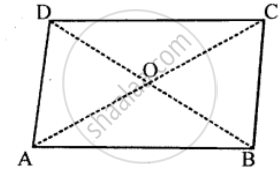
In parallelogram ABCD, its diagonals intersect at point O. If OA = 6 cm and OB = 7.5 cm, find the length of AC and BD.
If three angles of a quadrilateral are 90° each, show that the given quadrilateral is a rectangle.
D and E are the mid-points of the sides AB and AC respectively of ∆ABC. DE is produced to F. To prove that CF is equal and parallel to DA, we need an additional information which is ______.
If the sum of two angles is equal to an obtuse angle, then which of the following is not possible?
A pair of opposite sides of a trapezium are ______.
What conclusion can be drawn from part of given figure, if DC is the bisector of ∠ADB, CA ⊥ DA and CB ⊥ DB?

